Planar Magnetic Drivers in In-Ear Monitors: Engineering Constraints and Performance Variability
Update on March 9, 2026, 3:44 p.m.
Planar magnetic driver technology, once confined to high-end headphones costing thousands of dollars, has emerged in sub-$100 in-ear monitors. This transition from premium to accessible price points raises technical questions about miniaturization trade-offs, manufacturing consistency, and the factors contributing to polarized user experiences. This article examines the engineering principles underlying planar magnetic IEMs and analyzes documented performance variability within this product category.
Fundamental Operating Principles
Planar magnetic drivers differ fundamentally from the dynamic drivers found in most consumer earphones. A dynamic driver operates as a miniature loudspeaker: a voice coil attached to a cone-shaped diaphragm moves within a magnetic field, pushing air like a piston to generate sound waves. This mature technology delivers capable performance across all price ranges.
Planar magnetic drivers employ a distinct mechanism. The diaphragm consists of an extremely thin, flat film with etched electrical conductors distributed across its surface. This assembly suspends between arrays of precisely positioned magnets. When audio signal flows through the conductors, electromagnetic interaction causes the entire diaphragm surface to vibrate uniformly.
This operating principle produces several theoretically measurable advantages:
Transient Response – Distributed driving force across the diaphragm surface enables faster reaction to signal transitions. In acoustic measurements, this typically manifests as reduced rise time and decay time in transient response tests.
Distortion Characteristics – Uniform diaphragm movement minimizes breakup modes and flexing that occur in cone diaphragms at higher excursion levels. Total Harmonic Distortion (THD) measurements often show lower values compared to equivalent dynamic drivers at matching sound pressure levels.
Wavefront Consistency – Coherent diaphragm motion produces more uniform sound wave propagation, potentially contributing to stable frequency response at the ear canal entrance.
The engineering challenge involves miniaturizing this assembly to fit within IEM housings while maintaining the theoretical advantages observed in full-size implementations.
Historical Context: Market Evolution and Category Emergence
Planar magnetic technology entered consumer audio through large-format loudspeakers in the 1970s, notably from manufacturers like Magnepan. These panel speakers occupied substantial physical space and required significant amplification headroom.
High-end headphone applications emerged subsequently. The Sennheiser Orpheus (1991) incorporated electrostatic principles that influenced planar design philosophy. Audeze and HiFiMAN pioneered practical planar magnetic headphones in the 2000s, establishing the technology in the $1,000+ segment.
The transition to IEM form factors accelerated between 2019-2022. Several market developments converged:
Manufacturing Capability – Shenzhen-based audio manufacturers developed supply chains capable of producing micro-scale planar assemblies at reduced unit costs. Precision diaphragm etching and magnet array assembly, previously requiring specialized facilities, became achievable at consumer audio production scale.
Material Availability – Ultra-thin diaphragm materials (often sub-10 micron thickness) and rare-earth magnet arrays became accessible to mid-tier manufacturers through established component suppliers.
Category Validation – Products like the 7Hz Timeless (2021) and Letshuoer S12 (2021) demonstrated commercially viable planar magnetic IEMs in the $150-200 range. These releases established technical benchmarks and consumer interest, prompting broader market entry.
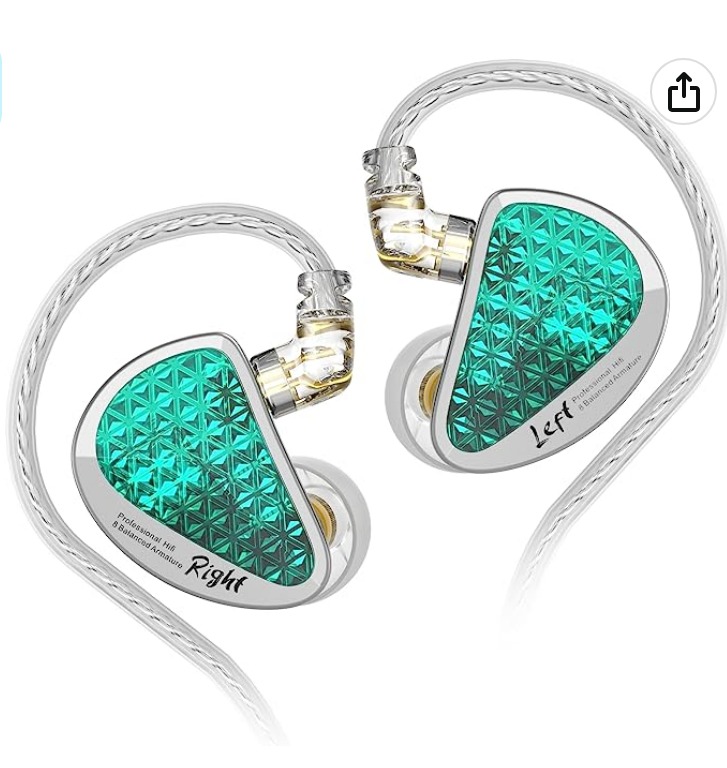
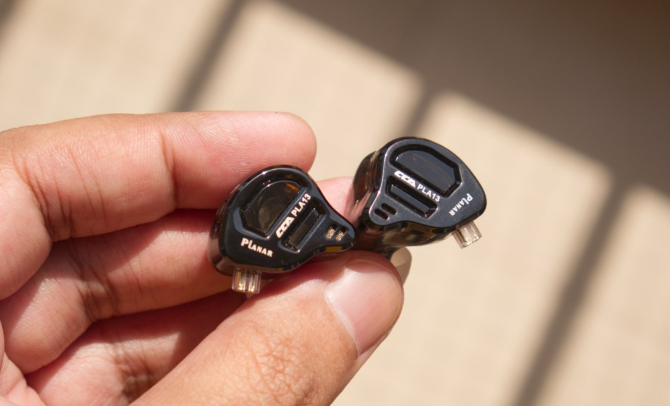
The CCA PLA13 emerged in mid-2022 positioned below the $100 threshold – part of a second wave of budget planar IEMs following initial category validation. Its 13.2mm driver ranks among the larger planar implementations in IEM form factor.
Acoustic Constraints in Miniaturized Implementation
Scaling planar magnetic technology from headphones to IEMs introduces physical limitations that directly affect measurable performance characteristics.
Surface Area Limitations
Full-size planar magnetic headphones typically employ diaphragms spanning 70-100mm in diameter. The CCA PLA13’s 13.2mm driver represents approximately 2% of the surface area of a typical 90mm headphone driver.
| Parameter | Full-Size Planar Headphone | Planar IEM (13mm class) |
|---|---|---|
| Diaphragm surface area | ~6,400 mm² | ~137 mm² |
| Air displacement potential | High | Limited |
| Bass extension (natural) | Extended sub-bass possible | Requires acoustic loading |
| Enclosure volume | 200-400 ml | 2-4 ml |
Air displacement scales with diaphragm surface area and excursion depth. Smaller drivers require greater excursion to achieve equivalent sound pressure levels at low frequencies, or must rely on acoustic loading from the ear canal seal to build bass pressure.
Enclosure Acoustics
The internal volume of an IEM shell – typically 2-4 cubic centimeters – creates acoustic conditions fundamentally different from headphone earcups. Resonant frequencies within small enclosures occur at higher frequencies, requiring careful internal damping and venting strategies.
The “dual-cavity” design referenced in some product specifications likely indicates acoustically isolated chambers positioned anterior and posterior to the driver assembly. This architecture can help manage backwave reflections and control resonant behavior within the confined housing volume.
Magnet Array Configuration
“Double-sided array magnets” – positioning magnet arrays on both sides of the diaphragm – increases magnetic field strength and uniformity across the driver surface. Stronger magnetic fields improve driver control and can reduce distortion from non-linear diaphragm behavior.
However, magnet strength and diaphragm tension must be balanced against manufacturing tolerances achievable at consumer audio price points.
Seal-Dependent Acoustic Performance
Eartip seal quality represents the most significant variable affecting measured frequency response in IEMs – particularly for bass reproduction.
The Acoustic Mechanism
Bass frequencies require controlled air pressure changes within the sealed ear canal cavity. An incomplete seal allows pressure waves to dissipate rather than propagate to the tympanic membrane. The physical result: reduced sound pressure level (SPL) at frequencies below approximately 300-500 Hz.
This is not driver-specific – it applies equally to dynamic, balanced armature, and planar magnetic IEMs. However, the perceptual impact may differ based on driver characteristics.
Measurement Considerations
Professional IEM reviews publish frequency response measurements obtained with standardized couplers (such as the IEC 60318-4 artificial ear). These measurements eliminate seal variability by using a fixed acoustic coupling. When reviewing user reports of “no bass” versus “hard-hitting bass” for identical products, seal quality represents the most probable explanatory variable – not driver unit differences.
Tip Matching Requirements
Individual ear canal geometry varies significantly across populations. IEM manufacturers typically include multiple eartip sizes (S/M/L), and often multiple tip styles (single-flange silicone, double-flange, foam). However, the included selection may not achieve optimal seal for all users.
Aftermarket eartips from specialists like SpinFit, Azla, or Comply offer varied geometries that can substantially alter both comfort and acoustic coupling. For users experiencing bass deficiency, systematic tip testing represents the primary diagnostic step before attributing issues to driver performance.
Documented User Experience Polarization
User reviews for budget planar magnetic IEMs frequently display bimodal distribution – clustering around highly positive and highly negative assessments with reduced representation in middle ratings.
Reported Experience Patterns
Analysis of available user feedback reveals consistent themes:
Positive reports frequently mention:
- Perceived clarity and detail retrieval
- Instrument separation and soundstage impression
- Comfort during extended wear
- Value proposition relative to price
Negative reports frequently mention:
- Bass quantity deficiency
- Inconsistent quality control (unit failure, channel imbalance)
- Rattling or distortion at higher volumes
- Expectation mismatch relative to marketing claims
Contributing Variables
Multiple factors likely contribute to experience polarization:
Manufacturing Consistency – Budget price points necessitate cost-optimized production processes. Driver unit matching, assembly tolerances, and quality control inspection rigor may vary from premium manufacturer standards. Unit-to-unit variation represents a documented concern in consumer audio at all sub-$100 price points.
Measurement Data Gap – Unlike professional review samples submitted to audio publications, retail units rarely undergo independent measurement verification. Frequency response consistency, channel matching, and distortion characteristics across production batches remain undocumented for most budget IEMs.
Source Equipment Variation – Users employ diverse source devices: smartphone headphone jacks, laptop outputs, dedicated dongle DACs, portable players, and desktop amplifiers. Output impedance, voltage swing, and current delivery capabilities vary substantially across these devices.
Psychoacoustic Factors – Listener expectations, prior experience, and preference weighting affect subjective assessment. A listener prioritizing bass quantity will assess the same product differently than one prioritizing midrange transparency.
Amplification and Source Matching
Planar magnetic drivers present distinct electrical load characteristics compared to dynamic drivers.
Impedance and Current Requirements
While specific published specifications vary by model, planar magnetic IEMs typically exhibit:
- Impedance: 15-30 ohms (lower than many dynamic IEMs)
- Sensitivity: 95-105 dB/mW (variable, often current-dependent)
Lower impedance combined with planar driver characteristics can create higher current demands at equivalent listening volumes. Source devices with limited current delivery capability may exhibit compressed dynamics or reduced maximum SPL.
Source Device Categories
| Source Type | Typical Output Impedance | Current Delivery | Compatibility Notes |
|---|---|---|---|
| Smartphone 3.5mm | 1-5 ohms | Limited | May suffice for moderate volumes |
| Laptop headphone | 10-50 ohms | Variable | Higher output impedance can affect frequency response |
| Budget dongle DAC | <1 ohm | Moderate | Improved voltage and current delivery |
| Dedicated DAP | <1 ohm | Good | Designed for audio load requirements |
| Desktop amplifier | <1 ohm | Substantial | Maximum headroom and control |
Damping Factor Considerations
Damping factor – the ratio of load impedance to source output impedance – affects driver control, particularly in bass frequencies. Lower source output impedance provides higher damping factor, potentially improving transient response and reducing bass “bloom.”
For planar magnetic IEMs with already-low impedance, source output impedance becomes more critical. A smartphone or laptop with 10+ ohm output impedance may provide noticeably different performance than a sub-1-ohm dongle DAC or dedicated amplifier.
Measurement-Based Evaluation Framework
Professional audio evaluation increasingly emphasizes objective measurement data alongside subjective listening impressions. Key metrics for planar magnetic IEM assessment include:
Frequency Response
The primary determinant of perceived tonal balance. Measurements should show:
- Smooth bass extension to at least 50-80 Hz for full-range reproduction
- Controlled midrange presentation without excessive peaks
- Treble extension and roll-off characteristics
Note: Individual ear anatomy affects high-frequency perception due to ear canal resonance. Measurements provide reference, but individual experience varies.
Total Harmonic Distortion (THD)
Planar magnetic drivers theoretically exhibit lower THD than dynamic drivers at equivalent SPL. Measurements typically show:
- <1% THD at 94 dB SPL (1 kHz) indicates good linearity
- Rising THD at higher SPL indicates driver limits or enclosure resonance
Impedance and Phase Response
Impedance curves reveal driver behavior across frequency. Significant impedance variation may indicate sensitivity to source output impedance.
Unit Matching
Left-right channel matching within 1-3 dB across the frequency spectrum indicates good manufacturing consistency. Larger deviations suggest quality control issues.
Engineering Trade-Offs Summary
Planar magnetic IEMs in the budget category involve documented engineering compromises:
| Design Factor | Full-Size Advantage | IEM Constraint |
|---|---|---|
| Diaphragm surface area | 6,000+ mm² | 100-200 mm² |
| Enclosure volume | 200+ ml | 2-4 ml |
| Manufacturing tolerance | Premium processes | Cost-optimized |
| Measurement validation | Standard practice | Rare at budget tier |
| Source requirements | Understood | Often unspecified |
These constraints do not preclude satisfactory performance, but they establish realistic expectations for what miniaturized planar technology can achieve at accessible price points.
Implications for Technical Assessment
When evaluating planar magnetic IEMs, several factors warrant consideration:
-
Seal verification precedes driver assessment – Bass response cannot be fairly evaluated without confirmed optimal eartip fit
-
Source equipment affects measurable performance – Output impedance and current delivery should match driver requirements
-
Unit variation remains undocumented – Without published measurement data for production units, individual experience represents limited sample size
-
Category comparisons require measurement context – Subjective impressions vary; frequency response and distortion measurements provide common reference
The emergence of planar magnetic technology in sub-$100 IEMs represents genuine engineering achievement. However, physical constraints and manufacturing realities create performance boundaries that differ from full-size implementations. Understanding these limitations enables more informed technical assessment.