Pamu S28 Wireless Earbuds: Your Perfect Workout Companion with ENC Noise Canceling
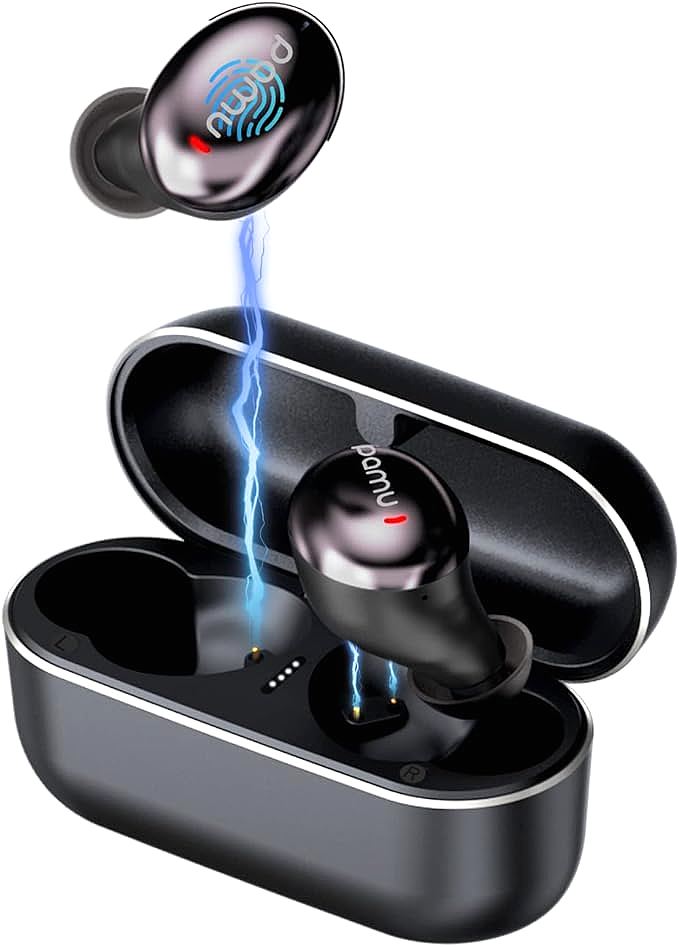
pamu S28 Wireless Earbuds
A journey into the invisible science behind your wireless earbuds, from cancelling sound waves to repelling water and riding radio signals.
Have you ever paused, midway through a bustling city street or in the cacophony of a gym, and marvelled at the pocket of peace your tiny earbuds can create? It feels like magic. A simple tap, and the world’s clamour recedes, replaced by the curated soundtrack of your choice. But this isn’t magic. It’s a meticulously choreographed battle against the fundamental laws of physics. It's a symphony of science playing out in a theatre the size of your ear canal.
The unassuming gadgets we use daily are portals to some of the most elegant principles in science and engineering. They are not merely products to be consumed, but stories to be understood. So, let’s embark on a journey beyond the brand names and marketing bullet points. Let's peel back the plastic shell and discover the hidden world of wave mechanics, material science, and radio communication that makes your modern audio experience possible.

Commanding a Symphony of Silence
To understand how you can erase a sound, you first have to understand what sound is. At its core, all sound—from a whisper to a jet engine—is simply a vibration. These vibrations create pressure waves that travel through the air, much like ripples spreading from a stone dropped in a calm pond. Each wave has a distinct shape, with peaks (high pressure) and troughs (low pressure). This shape defines everything we hear.
The secret to creating silence lies in a beautiful physics principle called destructive interference. Imagine that ripple in the pond. What would happen if you could simultaneously create a second, perfectly opposite ripple—one where its trough meets the first ripple’s peak, and its peak meets the first one’s trough? They would cancel each other out, and the water’s surface would return to calm.
This is precisely what high-tech audio devices do. The process begins with tiny, outward-facing microphones that act as sentinels, constantly listening to the ambient noise around you. They capture the incoming sound waves and instantly convert them into a digital signal. This signal is the enemy's battle plan.
The signal is then rushed to the device's brain, a minuscule but powerful chip known as a Digital Signal Processor (DSP). The DSP analyzes the noise wave’s shape in real-time and, with incredible speed, generates a brand new wave that is its perfect inverse—an "anti-noise" signal. This anti-noise is then played through the earbud's internal speaker. When the original sound wave from the outside world finally enters your ear, it meets its inverted twin. The peak meets the trough, and they annihilate each other.
You don't just block the sound; you actively cancel it.
It's crucial to note that this principle is applied in two distinct ways. Active Noise Cancellation (ANC) is focused on your experience, creating that bubble of quiet for your music. But another, more common technology is Environmental Noise Cancellation (ENC). This technology uses the same principles but applies them to the microphones picking up your voice during a phone call. Its goal isn't to make your world quieter, but to make your voice clearer to the person on the other end by erasing the background noise around you. A device like the pamu S28, for example, uses its ENC capabilities not for your listening pleasure, but as a courtesy to your caller, ensuring they hear your voice, not the café you're sitting in.

Building a Microscopic Fortress
The second great enemy of personal electronics is the environment itself, specifically, moisture. Sweat, rain, and accidental splashes are a constant threat. To combat this, engineers don't just rely on hope; they rely on a rigorous, internationally recognized standard: the IP Code.
IP stands for Ingress Protection, and it’s a universal language for describing just how fortified a device is against intrusion from solids (the first digit) and liquids (the second digit). You’ve likely seen ratings like IP67 or IP68 on high-end smartphones, signifying they can be fully submerged in water.
Many sports-focused earbuds, however, carry a rating like IPX4. Let's decode this. The 'X' simply means the device hasn't been tested against dust ingress. The '4' is the key. It certifies that the device is protected against splashing water from any direction.
This isn't just about making the casing tight. It's a two-pronged defense strategy involving material science and mechanical engineering. First, many internal components are coated with an invisible, hydrophobic nano-coating. This is a surface engineered at a molecular level to be extremely difficult for water to cling to. Instead of spreading out, water beads up and rolls off, just like on a freshly waxed car. Second, any potential entry points—seams, charging ports, microphone holes—are protected by precision-engineered rubber or silicone gaskets that form a watertight seal.
So, when a product like the pamu S28 carries an IPX4 rating, it's a scientifically backed promise. It means the engineering can withstand the sweat of an intense workout or a run in the rain. It also demonstrates a crucial design trade-off: achieving a higher rating like IPX7 (submersion) requires more robust, and often more expensive, sealing, which might not be necessary for the device's intended use. The IP code isn't just a spec; it's a window into the thoughtful balancing act of design.

Riding the Invisible Leash
Of course, none of this matters if you're tethered by a cable. The technology that set our audio free is Bluetooth, and it too has a fascinating story. Named in the 1990s by Ericsson engineers after the 10th-century Viking king, Harald "Bluetooth" Gormsson—famed for uniting the disparate tribes of Denmark and Norway—the technology was designed to unite different communication protocols.
Bluetooth operates in the crowded 2.4 GHz radio frequency band, sharing the airwaves with Wi-Fi, microwave ovens, and countless other devices. To avoid becoming a garbled mess, it employs a clever technique called Frequency-Hopping Spread Spectrum (FHSS).
Instead of transmitting on a single fixed channel, a pair of Bluetooth devices rapidly and constantly hops between dozens of different channels in a pre-agreed, pseudo-random sequence. It's the radio equivalent of having a conversation in a loud, crowded party by constantly jumping from one quiet corner to another, thousands of times per second. If one channel is noisy or occupied, the devices are only on it for a fraction of a second before hopping to a clear one. This makes the connection incredibly robust and resistant to interference.
But what about audio quality? For years, audiophiles lamented the quality loss over Bluetooth. This wasn't a flaw in the radio technology itself, but in the way audio data was packaged for its journey. This packaging is handled by an audio codec (short for coder-decoder). The most basic codec, SBC, prioritizes a stable connection over quality, sometimes resulting in audible compression. However, more advanced codecs like AAC and the aptX family can pack the data more efficiently, allowing for higher bitrates that preserve far more of the original recording's detail. The quest for true wireless "Hi-Fi" is largely a story of developing smarter codecs.

The Takeaway
The tiny devices nestled in our ears are far more than just accessories. They are pocket-sized triumphs of applied science. They wield the laws of wave physics to create silence, leverage materials science to defy the elements, and navigate the crowded radio spectrum with algorithmic grace.

They serve as a powerful reminder that technology, at its best, is an extension of human curiosity. It’s the result of us observing the world, understanding its rules, and then cleverly bending those rules to our will. So, the next time you tap your earbud and the world fades away, take a moment. Appreciate the invisible symphony of destructive interference, hydrophobic coatings, and frequency-hopping signals. You're not just listening to music; you're experiencing the elegant, tangible result of human ingenuity.
pamu S28 Wireless Earbuds
Related Essays

Symphonized FIT True Wireless Earbuds: Stay Secure and Sweatproof on Your Runs

Veho VEP-115-STIX-W Wireless Earbuds: Your Perfect Workout Companion

Bose SoundSport Free True Wireless Earbuds: Unleash Your Workout with Powerful Sound

How to Use anker noise cancelling earbuds properly

How to Use wireless earbuds bluetooth noise cancelling

How Component Commoditization Ended the Audio Price-Quality...

ZONWOO S1 Wireless Earbuds: Unleash Your Workout with 88H Playtime

Why Your Earbuds Keep Falling Out — And What Physics Says About Fixing It

IPX4 Waterproof Rating: What Splash Protection Really Means
