The Algorithm of Silence: Physics of Hybrid ANC and Driver Mechanics
Update on Dec. 31, 2025, 8:47 p.m.
Noise is entropy. In the context of information theory, it is the chaotic signal that obscures the message. In the context of daily life, it is the roar of the subway, the hum of the HVAC, the drone of the jet engine. For decades, the only defense against this auditory chaos was passive isolation—plugging the ear canal. But in the 21st century, we have moved from passive defense to active warfare.
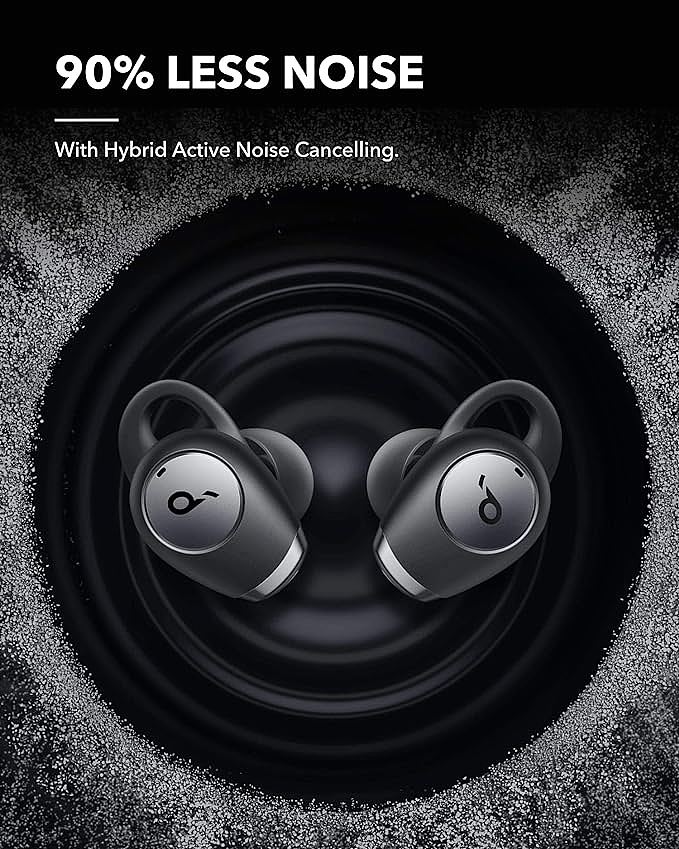
The Soundcore Life A2 NC represents the democratization of this technology. By deploying Hybrid Active Noise Cancellation (ANC) and massive 11mm drivers, it brings sophisticated acoustic physics to a price point once reserved for basic earbuds. This article deconstructs the wave mechanics of silence and the electromechanical muscle required to generate it.
The Physics of Wave Cancellation: Destructive Interference
At its core, ANC is a math problem. Sound travels as a pressure wave, consisting of compressions (peaks) and rarefactions (troughs). The principle of Superposition states that when two waves meet, their amplitudes add together.
The Anti-Noise Equation
If you take a noise wave ($N$) and generate a precise inverse wave ($-N$), where the peaks of the anti-noise align with the troughs of the noise, the sum is zero.
$$N + (-N) = 0$$
This is Destructive Interference. While conceptually simple, executing it in real-time is an engineering marvel. The latency between detecting the noise and playing the anti-noise must be microseconds. If the anti-noise arrives slightly late (phase shift), it can actually amplify the noise rather than cancel it.
Hybrid ANC: The Two-Front War
The Life A2 NC uses a Hybrid system, which is superior to single-feed systems.
1. Feedforward (The Sentinel): An external microphone detects noise before it enters the ear canal. This gives the DSP (Digital Signal Processor) a split-second head start to generate the anti-noise. It is excellent for reducing mid-to-high frequency noise (like traffic or voices) but can’t account for how the earbud fits in your ear.
2. Feedback (The Corrector): An internal microphone sits inside the ear canal, listening to what you actually hear. It compares the result to the desired audio signal. If any noise leaked through, the Feedback loop catches it and corrects the error. This is crucial for eliminating deep, low-frequency drones (like airplane engines).
By combining both, Hybrid ANC covers a wider frequency spectrum and is more forgiving of fit issues than Feedforward-only systems.

The Mechanical Muscle: 11mm Bio-Composite Drivers
Generating anti-noise is physical work. To cancel a loud low-frequency sound (like a bus engine at 80dB), the earbud driver must produce an 80dB anti-wave of the same frequency. This requires moving air.
The Physics of Diameter
Most TWS earbuds use 6mm drivers. The Life A2 NC uses 11mm drivers. * Volume Displacement: As discussed in previous analyses, bass requires volume displacement ($V_d$). An 11mm driver has roughly 3x the surface area of a 6mm driver. * The ANC Headroom: When ANC is active, the driver is doing double duty: playing your music and playing the anti-noise. Small drivers can run out of excursion (mechanical travel) when trying to do both, leading to distortion or weak bass. The oversized 11mm driver provides the necessary mechanical headroom. It can generate the powerful anti-waves needed for effective noise cancellation while still delivering the “Thumping Sound” of the music track without clipping.
Material Science: Bio-Composite
Large drivers can suffer from “cone breakup,” where the diaphragm flexes uncontrollably. Soundcore uses a “Bio-Composite” material (likely cellulose or silk fiber reinforced). * Self-Damping: Bio-materials often have high internal damping. This absorbs the micro-vibrations that cause harsh treble. * Rigidity: The composite structure ensures the diaphragm moves as a rigid piston, essential for the precise phase accuracy required for ANC. If the driver flexes, the phase of the anti-noise shifts, and the cancellation fails.
The Role of Digital Signal Processing (DSP)
The brain of the operation is the DSP. In the Life A2 NC, the “Multimode” feature relies on DSP algorithms. * Transport Mode: Prioritizes low-frequency cancellation (engines). * Indoor Mode: Prioritizes mid-frequency cancellation (voices, typing). * Outdoor Mode: Reduces wind noise (which can confuse the microphones).
This adaptability is a software layer sitting on top of the hardware physics. It demonstrates that modern audio is Computational Audio. The DSP analyzes the acoustic environment hundreds of times per second and adjusts the filter coefficients of the ANC algorithm dynamically.
Conclusion: The Quiet Revolution
The Soundcore Life A2 NC illustrates that silence is not the absence of sound; it is the presence of technology. By combining the brute force of 11mm drivers with the precision of Hybrid ANC algorithms, it creates a sanctuary in a noisy world.
For the commuter, the student, or the traveler, this technology is transformative. It lowers the noise floor of life, reducing cognitive load and allowing the brain to focus. It is a victory of physics over entropy.