Whispers Through the Jawbone: Navigating Acoustic Chaos in High-Decibel Environments
Update on March 4, 2026, 6:57 p.m.
In the sterilized environments of acoustic testing laboratories, designing a wireless headset is a matter of pursuing perfect frequency response and total harmonic distortion reduction. However, in the chaotic reality of a logistics hub, a construction site, or the cabin of a long-haul commercial truck, the acoustic priorities shift violently. High-fidelity audio reproduction takes a definitive backseat to raw signal intelligibility and the preservation of human situational awareness.
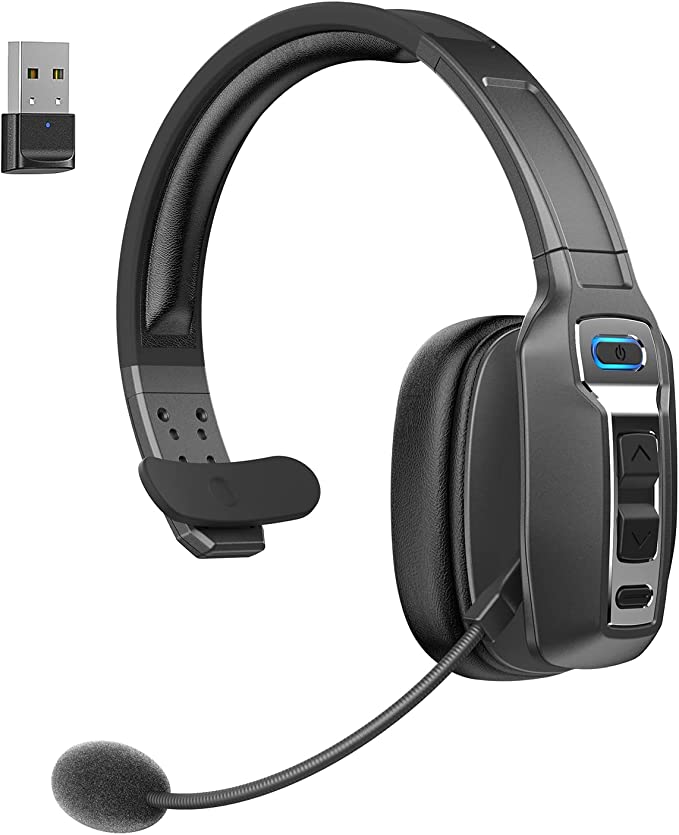
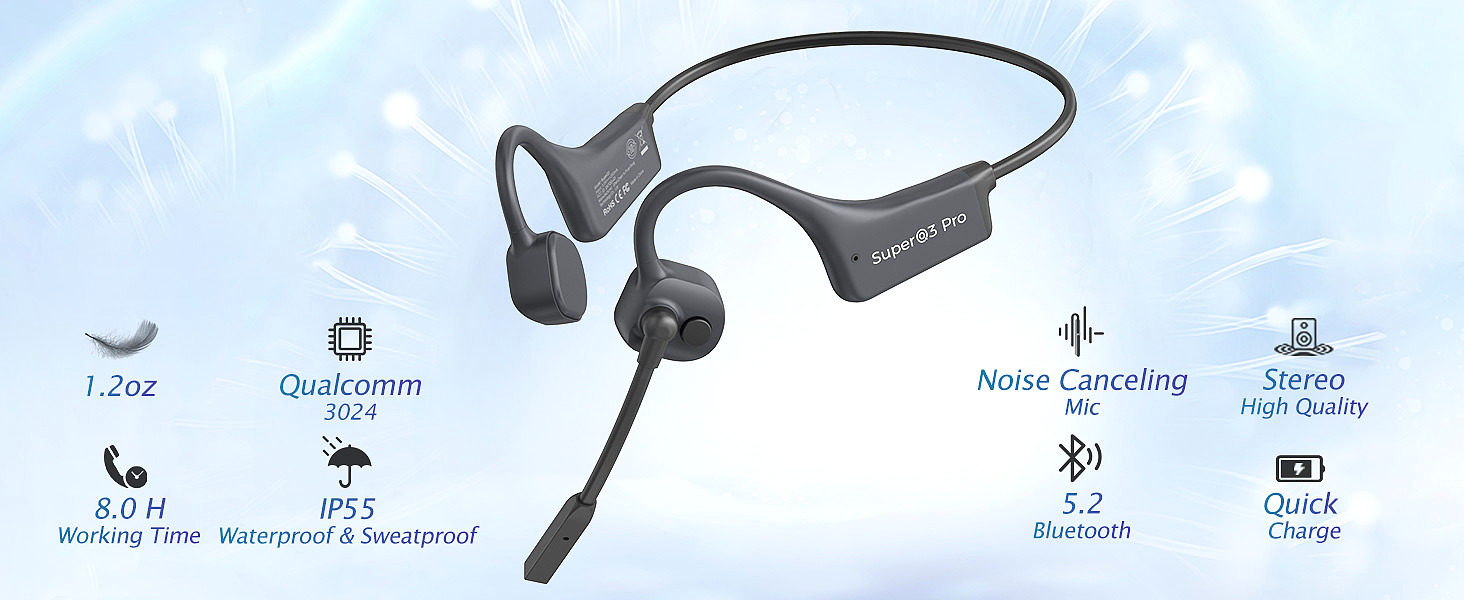
The engineering required to capture a human whisper while simultaneously rejecting the 95-decibel roar of a diesel engine involves a fascinating synthesis of human anatomy, wave physics, and digital protocol management. To examine this harsh acoustic frontier, we can look at the architectural decisions behind utility-focused devices like the Guudsoud SuperQ3-Pro. By combining an open-ear bone conduction framework with an aggressive, physical boom microphone, this hardware archetype forces us to rethink how audio is captured and delivered when the surrounding environment is actively hostile to communication.
From Beethoven’s Bite to Tactical Headsets
The premise of bypassing the external ear to deliver sound directly to the brain seems like a distinctly modern technological parlor trick, yet its foundational discovery dates back centuries, rooted in the desperate attempts to overcome human biological failure.
The most famous historical application of this principle involves the composer Ludwig van Beethoven. As Beethoven succumbed to severe conductive hearing loss—a condition where the mechanical structures of the outer and middle ear fail to effectively transfer sound waves to the inner ear—he discovered a crude mechanical workaround. By attaching a conductive rod to the soundboard of his piano and clenching the other end firmly between his teeth, he established a direct physical bridge. The vibrations from the piano strings traveled through the rod, into his jawbone, and directly into the cochlea, bypassing his damaged tympanic membrane (eardrum) entirely.
This mechanical phenomenon, known as osteophony, remained a medical curiosity for decades, utilized primarily in diagnostic tuning fork tests (such as the Weber and Rinne tests) to distinguish between sensorineural and conductive hearing loss. It was not until the mid-20th century that the military recognized the immense tactical advantage of osteophony.
Tactical operators, infantrymen, and aviators face a persistent paradox: they must remain in constant radio contact with their command units, but they cannot afford to sacrifice their natural acoustic awareness of their immediate surroundings. Blocking the ear canal with a traditional speaker driver removes the operator’s ability to hear approaching footsteps, distant vehicle engines, or the directional origin of a threat. Early military bone conduction headsets solved this by resting heavy, vibrating transducers against the temporal bone or cheekbone, leaving the ear canal completely unobstructed.
Today, this military-grade necessity has trickled down into civilian and industrial sectors. For a warehouse forklift operator or a commercial driver, the consequences of auditory isolation might not involve enemy combatants, but the risk of injury from unseen, unheard heavy machinery is equally lethal. The transition from crude copper rods to the sleek, piezoelectric actuators found in modern communication tools represents a massive leap in material science, yet the core anatomical exploit remains exactly the same as Beethoven’s.
The Skull as a Living Subwoofer
To understand how devices like the Guudsoud SuperQ3-Pro actually deliver audio, we must discard the traditional mental model of a loudspeaker pushing air. Standard earphones rely on acoustic impedance matching; they move a diaphragm to create variations in air pressure, which travel down the ear canal to vibrate the eardrum.
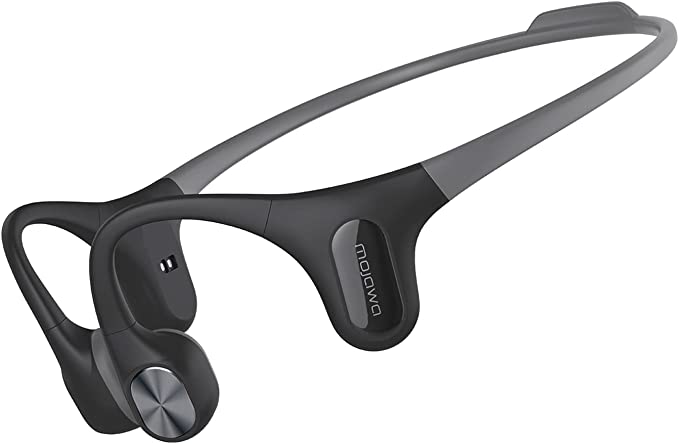
Bone conduction fundamentally alters the medium of transmission. Instead of generating air pressure waves, the headset utilizes specialized electromechanical transducers—often piezoelectric materials or specialized electromagnetic voice coils—designed to generate intense physical micro-vibrations. These transducers are positioned to rest firmly against the zygomatic arch (cheekbone) or the temporal bone just in front of the ear.
When the electrical audio signal drives the transducer, it vibrates against the skin. Because the acoustic impedance of skin and bone is drastically different from that of air, these vibrations propagate through the dense cranial structure, traveling directly to the fluid-filled cochlea. The hair cells within the cochlea bend in response to these vibrations, triggering electrical impulses to the auditory nerve, which the brain effortlessly decodes as sound.
However, treating the human skull as a subwoofer introduces severe acoustic limitations. Human bone and soft tissue do not transmit all frequencies equally. The skull acts as an aggressive natural low-pass filter. While low and mid-frequency vibrations (the fundamental frequencies of human speech, roughly 300Hz to 3000Hz) travel through bone with relative ease, high-frequency signals (above 4000Hz) are rapidly absorbed and dissipated by the dampening properties of human tissue.
This physical filtering effect is precisely why bone conduction headsets are rarely praised for their musical fidelity. They often sound “muffled” or lack the crisp, shimmering treble characteristic of high-end over-ear monitors. For an industrial user, however, this frequency roll-off is largely irrelevant. The hardware is acoustically tuned to prioritize the specific frequency bands where human speech resides.
Furthermore, true bone conduction requires immense clamping force to ensure efficient energy transfer between the transducer and the bone. To mitigate the severe physical discomfort of high clamping pressure, modern consumer and prosumer designs frequently employ a hybrid approach. They combine targeted bone vibration with intentional acoustic leakage—tiny directional ports that fire sound waves directly toward the concha of the ear. This hybrid method, often marketed under the broader umbrella of “open-ear” technology, allows the headset to rest lightly on the face while still achieving intelligible volume levels, cutting through the ambient noise of a busy environment.
Why Do Digital Algorithms Still Fail in a Diesel Cab?
While delivering audio to the user is half the battle, the far more complex engineering challenge is extracting the user’s voice from a chaotic background. Over the past five years, consumer audio has become obsessed with miniaturization, resulting in the proliferation of True Wireless Stereo (TWS) earbuds that sit flush within the ear, lacking any physical extension toward the mouth.
To capture a voice from the ear, TWS devices rely entirely on computational audio—specifically, microphone beamforming. By using arrays of microscopic omnidirectional microphones and calculating the minuscule microsecond delays as sound waves hit each mic, the internal processor attempts to create a “listening beam” steered toward the user’s mouth.
Yet, any truck driver who has attempted to take a dispatch call on highway-speed interstates using tiny earbuds knows the bitter truth: the algorithms routinely collapse. The person on the other end of the line hears a garbled, robotic mess, or the voice simply cuts out entirely.
The failure is not necessarily in the software code, but in the unforgiving realm of wave physics—specifically, the Inverse Square Law. This law states that the intensity of a sound wave is inversely proportional to the square of the distance from the source.
When a user speaks, the sound pressure level (SPL) is highest right at the lips. By the time that vocal sound wave travels the short distance across the cheek to a microphone embedded in a flush-mounted earbud, its energy has dissipated exponentially. Simultaneously, the ambient noise of the environment (the rumble of tires, the roar of a diesel engine, the hiss of wind) is bombarding the microphone from all directions. In a noisy cab, the ambient noise SPL at the earbud microphone is often equal to, or even louder than, the user’s degraded vocal signal.
This catastrophic drop in the Signal-to-Noise Ratio (SNR) starves the algorithmic processor. The software cannot separate the voice from the noise because, mathematically, the noise is louder.
This physical reality dictates the architectural necessity of the boom microphone. The Guudsoud SuperQ3-Pro, for instance, utilizes a boom arm with a maximum 220-degree rotation. This is not an aesthetic choice; it is a structural mechanism designed to bypass the Inverse Square Law. By physically relocating the microphone capsule from the temple down to within a few centimeters of the user’s mouth, the vocal signal strikes the diaphragm with immense, concentrated acoustic pressure. The voice is exponentially louder than the background noise. By solving the SNR problem in the physical acoustic domain first, the subsequent digital processing has a pristine, dominant reference signal to work with.

Pure Signal vs. Algorithmic Artifacts: The Processing Compromise
Even with a perfectly positioned boom microphone capturing a strong vocal signal, environmental noise still bleeds into the transmission. A high-quality capsule captures the user’s voice brilliantly, but it will also capture the hiss of an air brake releasing. To achieve the claim of blocking “90% of ambient noise,” raw acoustic capture must be paired with Digital Signal Processing (DSP).
The standard industry implementations for this are Clear Voice Capture (CVC, proprietary to Qualcomm) and Environmental Noise Cancellation (ENC). It is critical to differentiate these technologies from Active Noise Cancellation (ANC). ANC creates anti-phase sound waves to protect the wearer’s ears from external noise. CVC and ENC, conversely, operate exclusively on the microphone output to protect the listener on the other end of the call.
The processing architecture typically relies on a dual-microphone array on the boom itself. The primary microphone is positioned on the inner face of the boom, pointing directly at the mouth. A secondary microphone is positioned on the outer face, pointing away from the user, specifically designed to capture only the ambient environment.
The DSP chip receives both audio streams continuously. By utilizing Fast Fourier Transform (FFT) algorithms, the processor converts the analog audio waves into mathematical frequency data in real-time. The software analyzes the signal from the secondary microphone to establish a “noise profile”—a mathematical signature of the chaotic acoustic environment.
Using techniques like spectral subtraction, the algorithm actively subtracts the frequency footprint of the ambient noise from the primary microphone’s signal. If the secondary mic detects a sustained 500Hz rumble from a truck engine, the processor actively suppresses 500Hz frequencies in the primary voice channel.
The success of this computational cleanup is heavily dependent on the quality of the initial physical signal. In devices without a boom mic, where the voice and noise are mingled at low volumes, spectral subtraction frequently makes tragic errors, deleting parts of the user’s speech and creating bizarre, swirling “musical noise” artifacts. However, because a boom microphone provides a massive, high-amplitude vocal signal, the DSP has a clear threshold. It can aggressively slice away the background frequencies without accidentally amputating the core syllables of the user’s voice, resulting in the highly coveted “crystal clear” communication standard required in commercial operations.
When the Dispatch Call Interrupts Your Highway Playlist
In modern industrial workflows, audio hardware rarely communicates with just one piece of technology. A typical delivery driver or site manager is operating within a complex digital web: a tablet mounted to the dashboard running proprietary logistics and routing software, and a personal smartphone in their pocket.
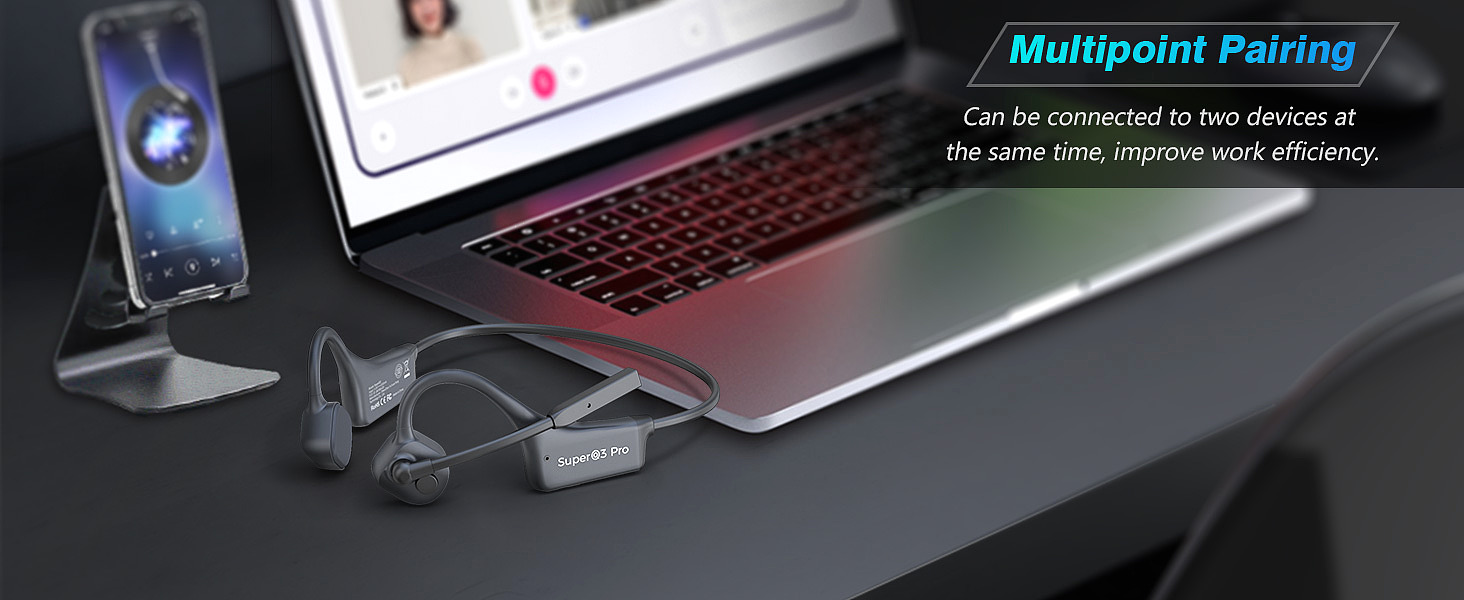
Managing multiple simultaneous wireless connections requires a specific layer of protocol engineering known as Bluetooth Multipoint. Early iterations of Bluetooth were strictly point-to-point, creating a rigid single master-slave relationship. If you wanted to answer a phone call on a different device, you had to manually dive into menus, disconnect from the first device, and initiate a handshake with the second—a dangerous and frustrating distraction while operating machinery.
Modern chipsets, such as the Bluetooth 5.2 modules integrated into headsets like the SuperQ3-Pro, resolve this through sophisticated Link Manager Protocol (LMP) handling. The headset acts as the central hub, capable of maintaining active asynchronous connectionless (ACL) links with two independent source devices simultaneously.
The true engineering challenge lies in the interrupt logic and bandwidth allocation. Bluetooth operates using various profiles. High-quality audio (like music or a podcast playing from the smartphone) streams over the Advanced Audio Distribution Profile (A2DP), which requires significant, continuous bandwidth. Voice calls, conversely, utilize the Hands-Free Profile (HFP) or Headset Profile (HSP), which require lower bandwidth but demand absolutely zero latency via Synchronous Connection-Oriented (SCO) links.
Consider the scenario: A driver is listening to music streaming from their personal phone via A2DP. Suddenly, the dispatch tablet initiates an incoming VoIP call. The headset’s firmware must execute an immediate, seamless hierarchy override. The processor instantly pauses or mutes the incoming A2DP packet stream from the smartphone and simultaneously opens the low-latency SCO link to the tablet to route the ringing notification and subsequent bi-directional voice data.
Once the call is terminated, the LMP tears down the active SCO link to the tablet and signals the smartphone to resume the A2DP stream. This protocol juggling act happens in milliseconds, totally invisible to the user. For the industrial operator, this means crucial routing updates or emergency calls are never missed, and they are never forced to take their hands off the steering wheel or controls to manage their digital connections.

Sleeping Radios Actually Work Harder Than You Think
A persistent source of confusion in wireless consumer electronics is the massive disparity between different battery life metrics. Specifications often highlight seemingly contradictory numbers: how can a device like the Guudsoud SuperQ3-Pro survive for a staggering 480 hours (20 days) on standby, yet deplete its entire lithium-polymer cell in just 8 hours of active use?
The answer lies in the intense energetic demands of the 2.4 GHz radio transceiver and the state-machine logic of the internal System-on-a-Chip (SoC).
When a Bluetooth headset is actively streaming music via A2DP, it is actually not working as hard as one might assume. Because audio playback is a unidirectional flow of data where slight delays don’t matter, the SoC can request data in large chunks. The radio transceiver wakes up, rapidly pulls down a burst of audio packets, fills a digital buffer, and then immediately powers down into a low-energy micro-sleep state while the processor decodes and plays the buffered audio. This intermittent duty cycle conserves significant energy.
Two-way communication via a boom microphone completely destroys this efficiency model. During a voice call over the HFP profile, the headset is required to maintain a continuous, real-time, low-latency connection. The radio must transmit the user’s voice packets and receive the caller’s voice packets simultaneously, dozens of times per second. The transceiver cannot sleep. Furthermore, the dual-microphone array is constantly powered, and the DSP is running high-intensity FFT algorithms non-stop to cancel environmental noise. This constant, high-power state drains the battery at an accelerated rate. Achieving 8 hours of talk time—a full working shift—requires a highly optimized micro-architecture.
Conversely, the 480-hour standby time demonstrates the extreme efficiency of modern Bluetooth Low Energy (BLE) protocols. When no audio is playing and no calls are active, the radio enters a “sniff mode.” It powers down almost entirely, waking up for only a few microseconds at pre-determined intervals (sniff intervals) to listen for a “page” or wake-up signal from the host device (e.g., an incoming call notification). If no page is detected, it instantly goes back to sleep.
The integration of fast-charging technology (yielding 1 hour of talk time from a 5-minute charge via Type-C) is a direct engineering response to these discharge realities. It acknowledges that industrial users cannot afford to have their communication tools tethered to a wall for hours during a mid-shift battery emergency. High C-rate charging algorithms allow the lithium-polymer cell to accept a massive influx of current safely for a brief window, providing emergency operational endurance exactly when it is needed.

Preserving Cognitive Bandwidth on the Logistics Floor
Ultimately, the deployment of acoustic technology in high-risk environments is not merely a matter of communication; it is a critical component of occupational safety and cognitive ergonomics.
The human brain relies heavily on auditory input to map its physical environment. Our auditory system utilizes complex calculations—specifically, Head-Related Transfer Functions (HRTF)—to determine the direction, distance, and velocity of sound sources. The brain analyzes the microsecond differences in when a sound arrives at the left ear versus the right ear (Interaural Time Difference), and how the physical shape of the outer ear (the pinna) slightly alters the frequency of the sound based on its origin point (Interaural Level Difference).
When an industrial worker inserts a traditional earplug or an isolating IEM (In-Ear Monitor) into their ear canal, they actively sabotage this biological radar system. They induce a state of artificial deafness. While high-end Active Noise Canceling (ANC) headphones offer “transparency modes” that use microphones to pump external sounds back into the speaker drivers, these digital recreations lack true spatial depth and can induce cognitive fatigue over long shifts.
This is the paramount advantage of the open-ear, bone-conduction form factor. By leaving the ear canal entirely unobstructed, the user’s natural acoustic radar remains fully online. They can perceive the exact directional hiss of a pneumatic valve releasing, the spatial location of a coworker calling their name, or the subtle, low-frequency rumble indicating that a heavy vehicle is backing up blindly in their direction.
In environments where auditory masking—the phenomenon where a loud sound completely hides the presence of a quieter, but crucial, sound—can lead to severe accidents, open-ear technology preserves the operator’s cognitive bandwidth. The user does not have to consciously focus on managing their isolation; they can effortlessly monitor their physical surroundings while simultaneously remaining tethered to their digital communication network.
The architecture of devices like the Guudsoud SuperQ3-Pro represents a specialized divergence in audio engineering. It abandons the pursuit of symphonic acoustic perfection in favor of rugged utilitarianism. By leveraging the physical realities of the Inverse Square Law via a boom microphone, routing data through cranial bone density, and utilizing sophisticated multipoint protocol management, it transforms a headset from an entertainment accessory into a vital industrial tool—ensuring that even in the most chaotic acoustic environments, the human voice survives the noise floor.