Bone Conduction Headphones Underwater: Why Bluetooth Fails and What Actually Works
A runner leaves the house, presses play, and a playlist streams from phone to earbuds without a second thought. A swimmer pushes off the wall and the same ritual collapses into silence. The phone sits on the pool deck, the earbuds sit thirty centimeters below the surface, and the music stops. Building bone conduction headphones underwater means confronting exactly this collision between consumer wireless technology and the physical properties of water.
Engineers have worked around the collision by changing what the signal travels through. Instead of pushing a radio wave through water, they push sound through bone. Water, the very substance that kills Bluetooth, turns out to be an excellent conductor for the vibration these devices produce. Pair that vibration with on-board music storage and the underwater listening problem mostly dissolves.
The Physics of Underwater Audio: Why Bluetooth Drowns
Bluetooth operates at 2.4 GHz, the same microwave band that heats food in a kitchen appliance. That is not a coincidence, and it is the root of the problem. A 2.4 GHz wave has a wavelength of roughly 12.5 centimeters in air, which is convenient for short-range communication. The same frequency interacts badly with water.
Water molecules are polar. Each carries a slight positive charge on its hydrogen side and a slight negative charge on its oxygen side, so the molecule behaves like a tiny antenna that flips back and forth when a microwave-frequency electric field sweeps through it. Every flip absorbs energy. A microwave oven exploits exactly this mechanism to heat food. A Bluetooth transmitter occupies the same frequency band. When a Bluetooth signal enters water, the water does to the signal what it does to cold soup: it absorbs it and turns it into heat.
The numbers are brutal. A 2.4 GHz signal in fresh water loses roughly half its power in the first few centimeters and keeps halving at that rate as depth increases. By the time a transmission from a phone on the pool deck reaches a pair of earbuds thirty centimeters down, almost nothing is left to decode. Salt water is worse, because dissolved ions add conduction losses on top of dielectric absorption. No firmware update changes this. No antenna redesign outpaces it. The physics is fixed.
That is why a swimmer who leaves a phone in a dry bag on deck, or even on the edge of the pool within arm's reach, hears nothing. The distance as the radio wave sees it is not the distance as the swimmer sees it. The first centimeter of water costs more signal than the entire air gap between phone and pool.
How Bone Conduction Routes Around the Ear Canal
If water destroys radio waves, it is remarkably hospitable to the right kind of mechanical vibration. Sound travels through water at roughly 1,480 meters per second, about 4.3 times faster than through air. Bone is faster still, around 3,400 meters per second in the skull. Bone conduction exploits both media by skipping the ear canal and driving the skull directly.
A bone conduction transducer is a small vibration motor held against the cheekbone, specifically the zygomatic arch, the ridge of bone that runs under the eye toward the ear. When the transducer shakes, it sends compression waves through the bone to the cochlea, bypassing the eardrum and the tiny bones of the middle ear. The cochlea cannot tell whether the vibration arrived through air or through bone. It converts the mechanical motion into nerve impulses, and the brain hears sound.
Underwater, this mechanism gets a boost rather than a penalty. The headset frame rests against skin, and water pressed between the transducer pad and the cheek acts as a coupling layer that improves the transfer of vibration into the skull. The acoustic impedance of water is much closer to that of soft tissue than air is, so less energy is lost at the boundary. Swimmers often report that audio actually sounds louder and fuller with the head submerged than with it dry. That is not imagination. It is impedance matching working in the listener's favor.
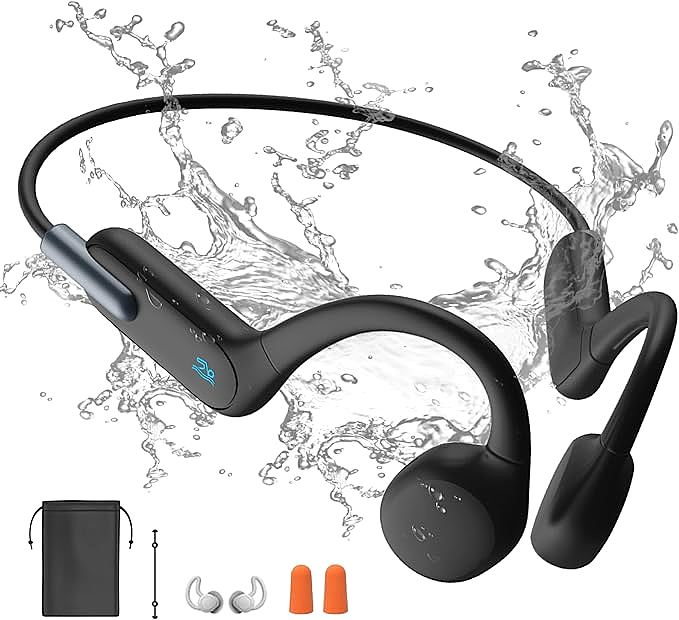
The Dnniakm X6 illustrates the approach: its transducers sit on the headband so the pads rest against the cheekbones rather than in or over the ears. The ears stay open. Water flows past them freely, and the sound arrives through a path that water improves rather than destroys.
Local Storage: Why On-Board Music Beats Bluetooth Below the Surface
Bone conduction solves only half the problem. It answers how sound reaches the inner ear underwater, but not where the audio signal comes from in the first place. If Bluetooth cannot penetrate water, the signal has to originate on the swimmer's own body. Every serious underwater audio device therefore carries its own music library.
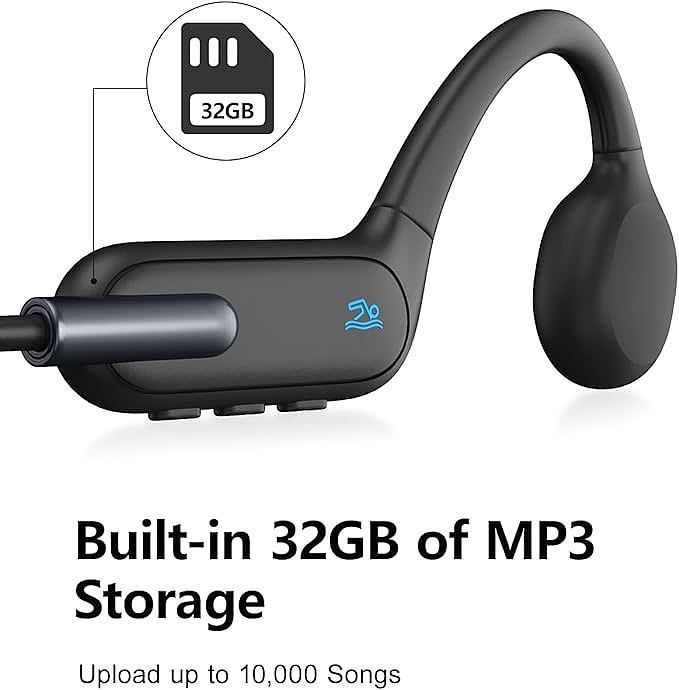
On-board storage converts the headphones into a self-contained waterproof MP3 player. There is no wireless link to maintain and no pool-deck phone to stay near. The audio file sits in flash memory, a processor decodes it, the transducer plays it, and the only thing that travels through water is the vibration against the skull. Thirty-two gigabytes of storage at typical compressed bitrates holds somewhere around six to ten thousand songs, more than most swimmers cycle through in a season.
Format support matters because swimmers pull music from many sources. A device that reads MP3, FLAC, WMA, AAC, WAV, APE, and M4A covers nearly every library a phone or streaming export is likely to produce. FLAC and WAV matter for listeners who care about dynamic range. MP3 and AAC matter because most downloaded and ripped music lives in those containers.
The switch between modes is usually mechanical. On devices like the Dnniakm X6, a double-click of the power button during startup toggles between Bluetooth and MP3 mode, so the same hardware serves a run on the road, with Bluetooth 5.3 streaming from a phone, and a swim in the pool, with standalone playback from internal storage.
IP68 Waterproof Engineering: Sealing Electronics Against Water
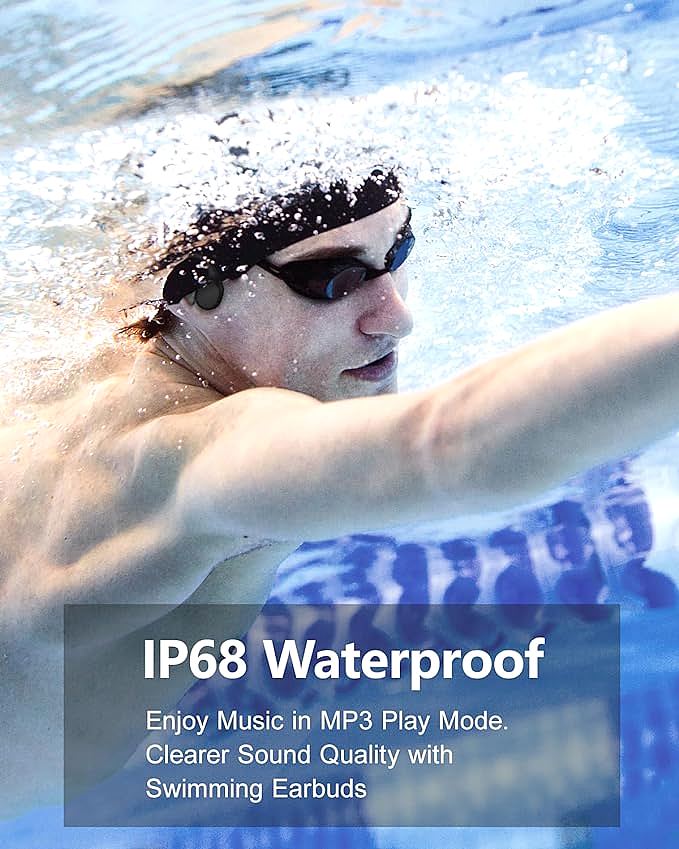
Carrying music on the head during a swim is only useful if the electronics survive the swim. This is where the Ingress Protection rating earns its keep. The IP code has two digits. The first rates protection against solid particles, and a 6 means dust-tight, with no ingress at all. The second rates protection against liquids, and an 8 means the device can be immersed beyond one meter under conditions specified by the manufacturer, typically one to three meters for consumer audio gear.
Reaching IP68 is less about a single heroic seal and more about eliminating every path water can find. The chassis is glued or ultrasonically welded shut where seams run. Buttons use internal rubber gaskets that compress when the housing closes, so each press deforms a compliant barrier rather than opening a hole. The charging port is the usual failure point on waterproof electronics, which is why modern underwater headsets abandon USB and use exposed magnetic pogo pins instead. A spring-loaded cable snaps onto the pins magnetically, current flows through plated contacts, and there is no opening to corrode or flood.
Chlorine and salt add a second axis of attack beyond simple immersion. Pool chlorine is an oxidizer that attacks rubber and certain plastics over time, and salt leaves conductive residue that can bridge the gap between charging pins. The engineering answer is material choice: corrosion-resistant plating on contacts, chlorine-stable elastomers on seals, and a maintenance habit of rinsing the headset in fresh water after every pool or ocean session. The rating says the device will survive submersion. The rinse habit determines whether it survives a few hundred submersions.
What Swimmers Actually Experience Below the Surface
Specifications describe the device. Reviews describe the experience. The two do not always agree, and the gap between them is where real understanding lives.
The dominant use case is tempo training. Lap swimming is repetitive by nature, and a consistent stroke rate is the difference between a paced set and an exhausted one. Swimmers load playlists organized by beats per minute so a 160 BPM track drives a faster stroke cadence and a 140 BPM track pulls them back for a recovery set. The music functions less as entertainment and more as a metronome that happens to be enjoyable. This is why tempo-training playlists dominate swimming audio sales volume.
The second use case is situational awareness in open water. Because bone conduction leaves the ear canal open, a swimmer in a lake or ocean can hear boat engines, kayaks, and the calls of a safety escort while still listening to music. Sealed in-ear earbuds cut that off, which is dangerous in open water. Open-ear conduction trades some isolation for safety, and in open water that trade is the correct one to make.
The underwater volume experience is counterintuitive. Because the transducer couples more efficiently through water, a level that feels correct on deck may feel overpowering on the first underwater lap, or, depending on the headset, softer, because the vibration now has two media to cross. The reliable approach is to set volume on the first lap and adjust from there rather than guessing on land.
Fit is the part no spec sheet captures. Head sizes vary, swim caps add compression, and goggle straps compete for the same real estate above the ears. A headband that adjusts across a wide range and holds the transducer pads firmly against the cheekbones makes the difference between clear audio and a muddy, low-volume murmur. Long-session reviews consistently flag fit as the single biggest factor in perceived sound quality, ahead of driver or codec.
Engineering Trade-offs Across the Underwater Audio Market
Underwater audio devices cluster around two engineering philosophies. The premium philosophy charges roughly $130 to $200 and delivers refined industrial design, a recognized brand, and a carefully tuned transducer, often with modest on-board storage. The budget philosophy charges $70 to $90, ships the same core feature set of bone conduction, IP68 sealing, and on-board MP3 storage, and accepts compromises in finish, long-term durability, and brand support.
The interesting fact about the budget end is how much it now includes. Features that were premium differentiators three years ago, namely 32 GB of on-board storage, Bluetooth 5.3 for land use, and a true IP68 submersion rating, have become baseline. A device like the Dnniakm X6 at $79.99 carries all three, where a premium alternative such as the Shokz OpenSwim often carries a comparable transducer and IP68 rating but historically shipped with much smaller storage.
The trade-offs at the lower price are real. Reviews in this tier consistently mention two issues: charger and contact quality over the long term, and button feel. Magnetic pogo-pin cables are easy to misplace and sometimes sit loosely on the contacts, which can cause failed charges. Over many months, exposed pins can develop pitting if not rinsed. These are not catastrophic flaws, but they explain why a $79 device and a $150 device can sound nearly identical on day one and diverge by month twelve. The premium price buys durability and support, not better underwater physics.
Using Bone Conduction Headphones Underwater: Practical Considerations
Setting up an underwater headset rewards a few minutes of preparation before the first lap.
Load the library first. Copy MP3, FLAC, WMA, or AAC files onto the headset over its magnetic USB cable the same way files move onto any external flash drive. Organize by folder if the device reads folder structure, or flatten everything if it reads by metadata. Test playback on dry land with the device in MP3 mode before trusting it in the pool.
Switch modes deliberately. A double-click of the power button during boot toggles between Bluetooth and MP3 on most headsets in this category. For a swim, the device must be in MP3 mode before the head goes under, because the mode switch is not always possible once submerged.
Manage volume per medium. Start lower than feels right on deck. The coupling effect changes perceived loudness underwater, and a setting that is comfortable in air can be piercing through water. Find the level on the first lap and leave it.
Use ear plugs for a tighter perceived seal. This sounds counterintuitive for an open-ear device, but blocking the ear canal removes one escape path for ambient water noise and redirects perception toward the bone-conducted signal. Many swimmers report cleaner, more present audio with silicone ear plugs in place.
Test in shallow water first. Swim a single easy lap at the shallow end and confirm playback, fit, and volume before committing to a long set. A loose transducer pad or a half-engaged mode switch is easy to fix on deck and miserable to fix mid-set.
Rinse after every session. Fresh water after chlorine or salt prevents the slow accumulation of residue that degrades contacts and stiffens seals over months. This single habit does more for device longevity than any specification on the box.
Matching Underwater Audio Technology to Swimming Routines
The technology fits some routines cleanly and others not at all. Competitive pool swimmers who train structured sets get the most value, because tempo-matched music directly supports their pacing. Open-water swimmers gain both motivation and the safety of an unblocked ear canal, which sealed earbuds cannot offer without a safety trade-off. Triathletes value the crossover: the same headset runs Bluetooth on the bike and the run, then switches to MP3 mode for the swim leg.
The fit is poorer for listeners who prioritize fidelity. Bone conduction cannot match a sealed in-ear monitor for bass response or isolation, because the transducer is driving bone, not a column of air trapped in a canal. Audio purists, bass-focused listeners, and anyone who wants active noise cancellation will be disappointed underwater or above it. The format is a tool for the water, where the alternatives simply do not work, not a general-purpose upgrade over conventional earbuds.
Casual listeners who never swim will not notice the advantage and will feel only the compromises. For them, the deciding question is whether open-ear safety and water capability matter in their routine. If they do not, a conventional waterproof earbud costs less and sounds better on land.
Working With Water Instead of Against It
The instinct when technology fails is to look for a stronger signal, a better antenna, a newer protocol. Underwater audio resists that instinct completely. The problem is not that Bluetooth is too weak. The problem is that the medium is hostile to the signal at a molecular level, and no amount of radio engineering overcomes the fact that water absorbs 2.4 GHz radiation on purpose, by the same mechanism a microwave oven uses to heat soup.
The lesson from bone conduction headphones underwater is that the way past a hard physical limit is usually to change the medium, not to fight the limit. Radio cannot go through water, so the audio source moves onto the swimmer's body. Air is a poor coupler to bone, so the transducer uses the water itself as the coupling layer. Every design choice in a working underwater headset is an act of agreeing with the physics rather than arguing with it.
The result is unspectacular in the best way. A swimmer pushes off the wall and the music is simply there, as present on lap forty as on lap one, with no dropouts to explain and no signal to chase. That quiet reliability, more than any specification, is what makes the category work.