PHILIPS p2000 Wired Headphones: An In-Depth Look at Budget Over-Ear Audio

What Are the PHILIPS p2000 Over-Ear Headphones?
The PHILIPS p2000 Over Ear Wired Stereo Headphones occupy a specific niche in the budget audio market: a $19.99 circumaural headphone that bridges consumer convenience and semi-professional utility. The philips p2000 wired headphones occupy a specific niche in this space, and Released in April 2020 by the heritage audio brand with over a century of sound reproduction experience, these wired headphones have accumulated more than 2,500 Amazon.com reviews at a 4.1-star average, signaling genuine market validation.
Unlike most sub-$30 headphones that offer a single 3.5mm connector, the p2000 includes a snap-on 6.3mm (1/4") adapter — a feature rarely seen below the $40 price tier. This dual-connectivity approach reflects a design philosophy aimed at users who span both portable and professional audio ecosystems. Whether plugged into a smartphone, a desktop audio interface, or a guitar amplifier, the p2000 attempts to deliver consistent performance across diverse source devices.
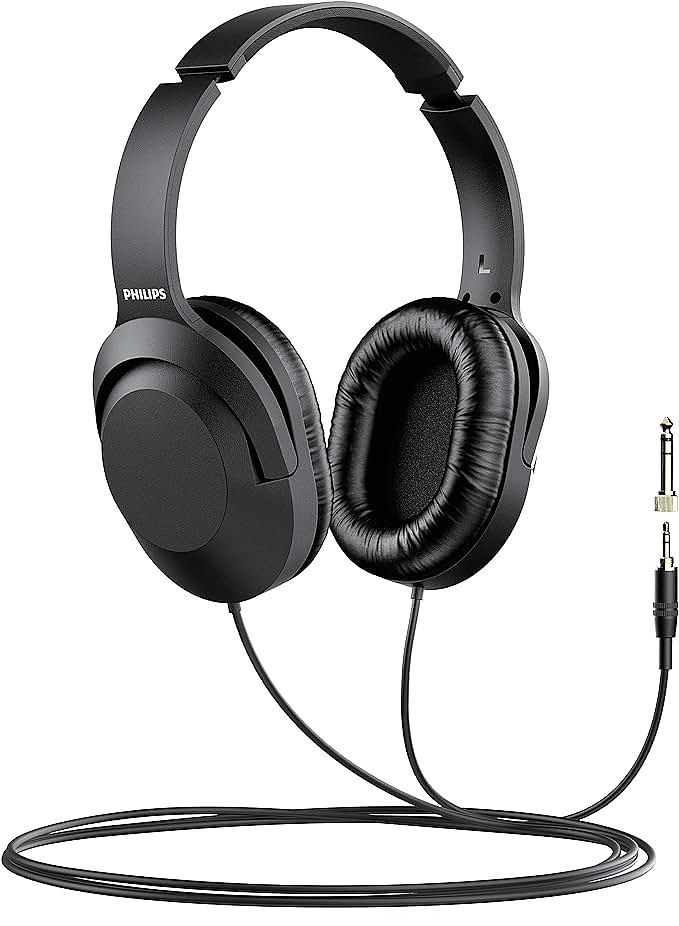
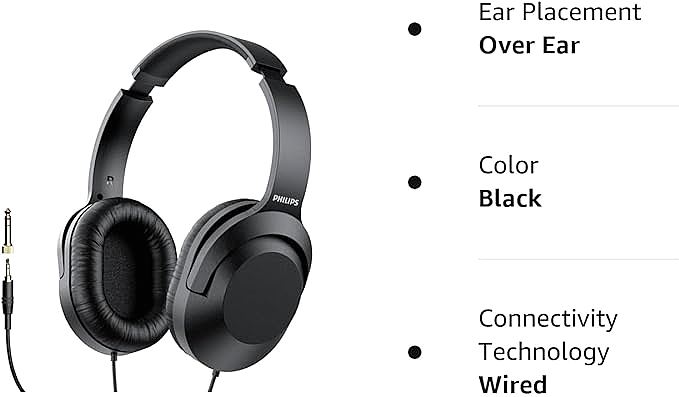
The headphones feature a closed-back circumaural design with 90-degree rotating earcups, a 2-meter cable, and weighs 8.8 ounces (250g). Available in Black and Silver, they are manufactured in the USA — an uncommon designation for budget headphones. The combination of rotating earcups, professional-grade connector compatibility, and US assembly positions the p2000 differently from typical budget alternatives that prioritize cost reduction above all else. For buyers seeking reliable philips p2000 wired headphones at this price point, the dual-connector design is a standout feature.
How Closed-Back Design Creates Passive Sound Isolation
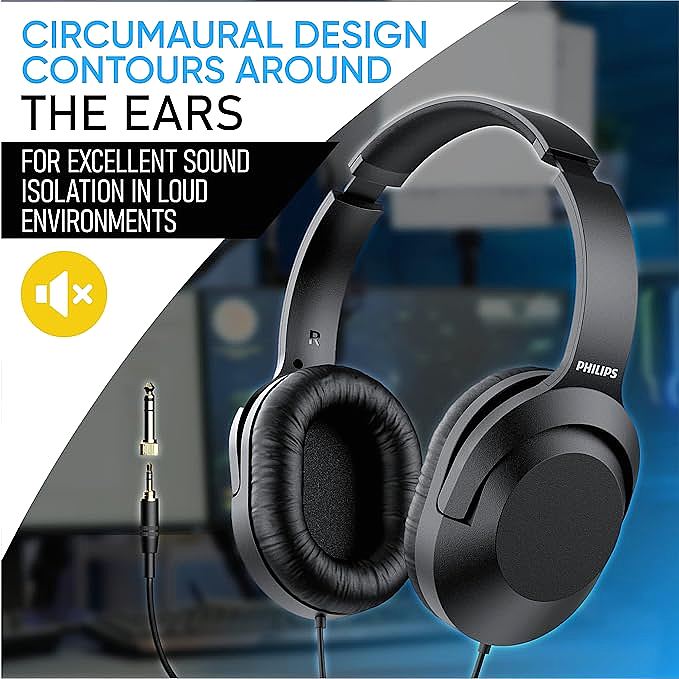
The p2000 employs a closed-back circumaural architecture, meaning each earcup completely encloses the ear and forms a sealed acoustic chamber. This design choice carries significant acoustic consequences that extend far beyond mere comfort considerations.
Passive noise isolation is the primary benefit of a closed-back design. The sealed earcup prevents external sound from entering while simultaneously containing the headphone's sound output. Acoustic physics suggests that well-designed circumaural closed-back headphones typically achieve 15-25 dB of ambient noise reduction. This is sufficient to mask conversation-level noise (approximately 60 dB) down to a manageable background level of roughly 35-45 dB, making these headphones suitable for office environments, classrooms, and public transportation.
The trapped air inside the sealed earcup also acts as an acoustic spring, adding stiffness to the driver's suspension at low frequencies. This typically produces a bass boost of 3-6 dB below 100 Hz compared to similarly constructed open-back designs. For a budget headphone at this price point, this characteristic enhances the perceived warmth and fullness of the sound without requiring expensive driver modifications.
However, the sealed cavity introduces trade-offs. Standing waves can develop at specific resonant frequencies within the earcup, potentially coloring the sound. Budget manufacturers typically mitigate this with basic damping materials, though the extent of such treatment is difficult to verify without physical disassembly. Additionally, the sealed design can create a sensation of ear pressure during extended listening sessions for some users — a factor that may contribute to the comfort complaints noted in a subset of reviews.
Understanding the 40mm Dynamic Driver and Frequency Response
At the heart of the p2000 lies a 40mm dynamic driver — the standard and widely regarded as optimal size for over-ear headphones in this category. Dynamic drivers operate on electromagnetic induction principles: an audio signal passes through a voice coil suspended within a magnetic field, generating force that moves a diaphragm and produces sound waves. This technology, dating back to Rice and Kellogg's 1925 development at General Electric, remains dominant in consumer headphones due to its favorable balance of cost, performance, and manufacturability.
The manufacturer-quoted frequency response of 10 Hz to 23,000 Hz exceeds the typical human hearing range of 20 Hz to 20,000 Hz. The 10 Hz sub-bass extension allows reproduction of frequencies that listeners may feel as physical vibration rather than hear as distinct pitch. The 23 kHz upper margin provides headroom for natural roll-off characteristics that can prevent harshness in the highest audible frequencies.
frequency response range alone does not indicate sound quality — it measures the range of frequencies the driver can produce at some measurable level, not the accuracy or flatness of reproduction across that range. Without access to the p2000's measured frequency response curve, informed inference from the 3.5/5 sound quality rating suggests competent but not exceptional reproduction, particularly in the midrange where vocal clarity resides.
Philips does not publish the p2000's impedance or sensitivity specifications. Based on comparable 40mm budget over-ear headphones, the estimated impedance falls in the 16-32 ohm range, and estimated sensitivity is approximately 95-110 dB/mW. These estimates are critical for understanding the volume behavior that numerous reviewers have documented.
What 2,500+ Amazon.com Reviews Reveal About Real-World Performance
The 2,573 Amazon.com ratings for the p2000 provide a statistically meaningful sample of real-world performance data. The distribution shows 58% five-star ratings, 17% four-star, 11% three-star, 5% two-star, and 9% one-star. Combined, 75% of reviewers rate the headphones 4 stars or above — a strong indicator for the ultra-budget segment.
Feature-level ratings further illuminate user experience: comfort scores 4.0/5, sound quality 3.5/5, and noise cancellation 3.4/5. The fact that comfort ranks higher than sound quality aligns with the product's positioning as a practical everyday headphone rather than a critical listening tool.
Positive themes cluster around versatility and value. Reviewers consistently praise the headphones' ability to work with diverse audio sources — MIDI engines, guitar amplifiers, smartphones, and computers — often describing them as "great sound for the money." The 6.3mm adapter receives specific mention as genuinely useful for musicians and studio users. The 2-meter cable length is frequently cited as providing satisfying freedom of movement.
The negative feedback tells a more focused story. Volume limitation emerges as the dominant complaint, with multiple reviewers noting the headphones "don't get loud enough" even at maximum source output. A smaller but notable group reports complete failure after extended use, pointing to potential durability concerns. The unlabeled left/right earcups cause confusion for first-time users, and some reviewers note comfort degradation during sessions exceeding two hours.
Notable review perspectives include a professional musician who reported the headphones working flawlessly with MIDI engines and guitar amps when more expensive alternatives refused to connect, and multiple users confirming suitability for digital piano practice where the closed-back design prevents sound leakage into the room.
The Volume Question: Why the PHILIPS p2000 Might Not Get Loud Enough
Volume limitation is the single most consistent negative theme across the p2000's review corpus. Understanding why this occurs requires examining the intersection of driver sensitivity, source device output, and potential safety design choices.
The most probable explanation involves the estimated driver sensitivity of 95-98 dB/mW at the lower end of the budget range, combined with the limited output power of smartphone headphone jacks, which typically deliver 30-50 mW. When these figures are combined, the maximum acoustic output may fall short of what users accustomed to more sensitive headphones expect.
The p2000 is designed for dual-purpose use — both portable consumer devices and professional audio equipment. Smartphone users connecting directly via the 3.5mm jack may encounter volume limitations that disappear entirely when the same philips p2000 model is connected to a desktop audio interface or guitar amplifier through the 6.3mm adapter, where output power is substantially higher.
Some reviewers have speculated that the volume behavior reflects an intentional safety-limit design. The World Health Organization recommends keeping listening volumes below 85 dB for extended periods, and incorporating output limitation into budget headphones serves as a low-cost hearing protection mechanism. Whether Philips intentionally engineered this limitation remains unconfirmed, but the effect on user experience is identical regardless of intent.
For users experiencing volume limitations, practical solutions include connecting to equipment with dedicated headphone amplifiers, utilizing the 6.3mm adapter with audio interfaces or mixers that provide higher output, or selecting source devices known for stronger headphone jack performance. Understanding these volume characteristics is essential before purchasing philips p2000 wired headphones, as expectations should align with the intended use case. The philips p2000 wired headphones deliver reliable performance when matched to appropriate source equipment, making them a sensible choice for budget-conscious audio enthusiasts.
PHILIPS p2000 vs. Alternative Budget Headphones
At $19.99, the p2000 operates in the most competitive segment of the headphone market. Evaluating its position against direct competitors reveals both distinctive advantages and clear trade-offs.
The Anker Soundcore Life Q20 ($39.99, 4.4 stars, 87,000 reviews) offers active noise cancellation, Bluetooth wireless connectivity, and memory foam earcups — features the p2000 cannot match. However, the Q20 costs exactly double, requires periodic battery charging, introduces additional failure points through electronic components, and weighs more. The p2000 wins on price, absolute simplicity, zero-latency wired connection, and the inclusion of a 6.3mm adapter — features the Q20 lacks entirely. When comparing philips p2000 wired headphones against wireless alternatives, the zero-latency wired connection remains a decisive advantage for musicians and gamers.
The KZ ZSN Pro X ($25.99, 4.3 stars, 12,000 reviews) represents a fundamentally different form factor: in-ear rather than over-ear. Its balanced armature plus dynamic hybrid driver delivers superior audio fidelity, and its detachable cable extends lifespan. However, in-ear designs provide less passive isolation than circumaural models, and the ZSN Pro X does not include a 6.3mm adapter.
The Moondrop Chu II ($21.99, 4.4 stars, 8,500 reviews) shares the in-ear form factor with detachable cable and metal construction. It offers VDSO-targeted tuning for more accurate reproduction but serves a different use case entirely. Neither the KZ nor the Moondrop provides over-ear comfort or professional connector compatibility.
Among budget over-ear wired headphones specifically, the p2000 holds a unique position as the only sub-$25 option that includes a 6.3mm adapter. For anyone searching for reliable philips p2000 headphones that work with both consumer and professional equipment, this distinction matters significantly.
Who Should Buy These Wired Headphones
The p2000 serves several user profiles particularly well. Hobbyist musicians and producers benefit most from the 6.3mm adapter, which enables direct connection to audio interfaces, mixing consoles, and instrument amplifiers without requiring additional adapters. The closed-back design prevents sound leakage during practice sessions, making these headphones viable for wired headphones for studio monitoring applications.
Digital piano and keyboard players represent another strong fit. The sealed acoustic design contains sound within the earcup, preventing practice audio from disturbing others — a concern repeatedly validated by reviewers who specifically mentioned piano use. The wired connection eliminates battery anxiety and latency concerns inherent in wireless alternatives.
Budget-conscious PC gamers find value in the zero-latency wired connection, effective passive isolation from room noise, and the 2-meter cable providing comfortable desk-to-chair distance. At $19.99, the financial risk of a gift purchase or trial headphone is minimal.
Students and casual listeners appreciate the plug-and-play simplicity of philips p2000 wired headphones, along with the absence of charging requirements. Travelers benefit from the passive noise isolation, which can replace low-quality airline earbuds on flights. The straightforward 3.5mm connection eliminates the need to manage batteries or deal with pairing issues that plague wireless alternatives in transit.
These headphones are less suitable for users who primarily listen through smartphone headphone jacks and require maximum volume output, audiophiles seeking critical listening fidelity, or anyone prioritizing wireless convenience over signal integrity.
Build Quality, Durability, and Care Tips
The p2000's circumaural design incorporates padded synthetic leather ear cushions and a lightweight headband. At 8.8 ounces, the weight distribution is generally comfortable for sessions up to two hours, though some users report pressure point fatigue during extended use.
The most common failure mode in budget wired headphones — and the likely cause of the 9% one-star rate affecting approximately 230 of 2,573 reviewers — is cable fracture at the strain relief point where the cable enters the earcup or terminates at the 3.5mm connector. This failure accelerates dramatically when cables are stored tightly wound or subjected to repeated sharp bending.
To maximize the p2000's service life, avoid sharp bends in the cable, store the headphones loosely coiled rather than tightly wrapped, clean the ear cushions periodically with a slightly damp cloth to prevent material degradation, and always grip the connector — not the cable — when unplugging from source devices. Keeping the 3.5mm connector clean and dry prevents oxidation that causes intermittent audio.
The 90-degree rotating earcup mechanism, while convenient for folding and one-ear monitoring, represents an additional wear point. Over extended use, the rotation mechanism may loosen, reducing the snugness of the earcup seal and consequently degrading bass response and passive isolation effectiveness. Users who prioritize long-term reliability from their philips p2000 wired headphones will appreciate the straightforward, repair-friendly design that minimizes complex electronic components.
What's in the Box
The package contains the headphones unit with pre-installed ear cushions, a 2-meter audio cable terminated with a 3.5mm jack, a snap-on 6.3mm (1/4") adapter, and packaging measuring 8.66 x 6.81 x 3.31 inches. No carrying case or additional accessories are included at this price point. This no-frills approach to what is included reinforces why these philips p2000 wired headphones remain competitively priced.
| Specification | Value |
|---|---|
| Brand | PHILIPS |
| Model | p2000 |
| ASIN | B085899TQ9 |
| Driver | 40mm dynamic |
| Frequency Response | 10 Hz – 23,000 Hz |
| Connectivity | Wired, 3.5mm + 6.3mm adapter |
| Form Factor | Over Ear (Circumaural, Closed-Back) |
| Cable Length | 2 meters |
| Weight | 8.8 oz (250g) |
| Earcups | 90-degree rotating |
| Colors | Black, Silver |
| Price | $19.99 |
| Rating | 4.1/5 stars (2,573 reviews) |
| BSR | #1,461 Electronics, #83 Over-Ear Headphones |
| Country of Origin | USA |