Acoustic Architecture: How Hybrid ANC and LCP Drivers Redefine Budget Audio
Update on Feb. 11, 2026, 12:57 p.m.
Sound is not merely a sensory input; it is a physical force that shapes our perception of reality. In urban environments, this force is often chaotic—a barrage of low-frequency engine rumbles and high-frequency mechanical whines. Restoring order to this auditory landscape requires precise engineering. The UMIDIGI Ablebuds Free serves as a fascinating case study in how advanced acoustic principles, once reserved for laboratory-grade equipment, are being miniaturized to create personal sanctuaries of silence and fidelity. By leveraging the physics of destructive interference and advanced material sciences, these devices demonstrate that high-performance audio is a matter of smart engineering, not just high cost.
The Calculus of Silence: Hybrid ANC Explained
To understand how a headphone can silence a jet engine, one must first understand the wave nature of sound. Sound propagates as pressure waves, consisting of compressions (peaks) and rarefactions (troughs). Active Noise Cancellation (ANC) exploits a phenomenon called destructive interference. If a sound wave meets an inverted copy of itself—where a peak meets a trough—the two waves sum to zero, effectively canceling the sound energy.
The “Hybrid” architecture employed in the Ablebuds Free represents a significant leap over standard feed-forward systems. A basic system uses a single microphone on the outside to estimate noise, but it cannot know what the user actually hears. The Hybrid approach utilizes a dual-microphone topology:
- Feed-Forward Loop: An external microphone samples ambient noise (like traffic) and generates an initial anti-noise wave.
- Feed-Back Loop: An internal microphone, placed inside the ear canal, listens to the residual sound that managed to bypass the first defense. It compares this to the original audio signal and generates a secondary correction signal.
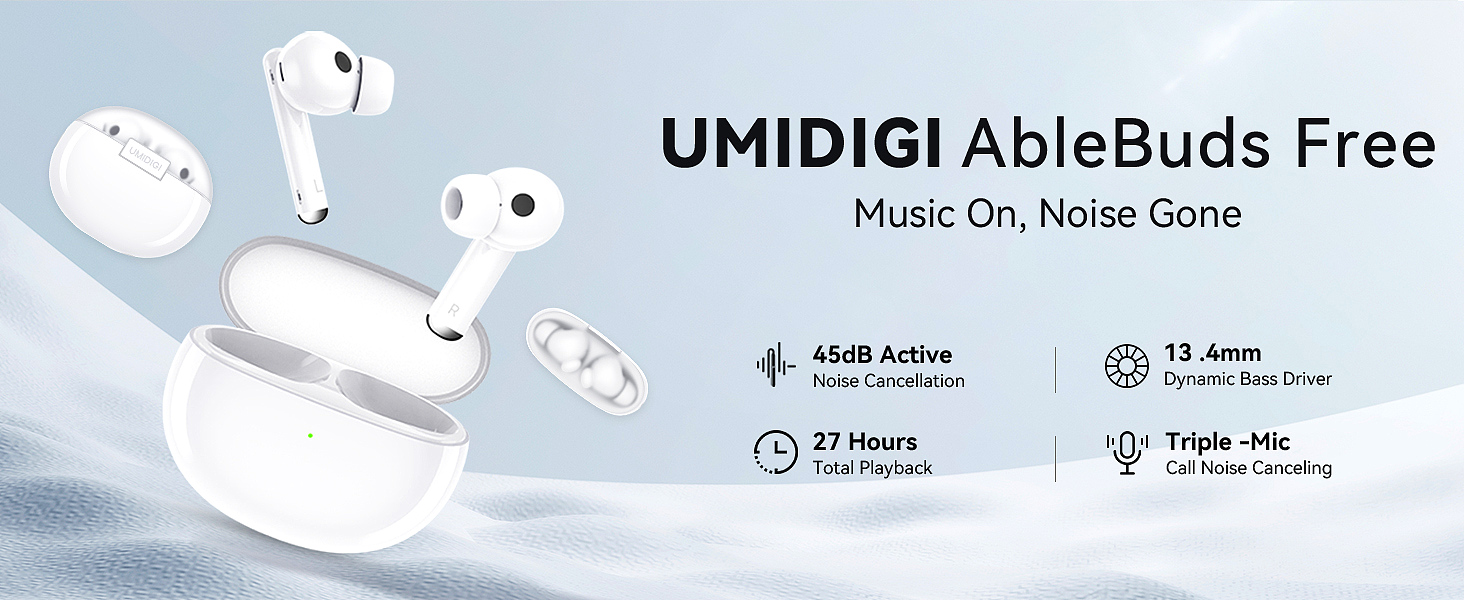
This closed-loop feedback system allows the device to achieve a noise reduction depth of up to 45dB. Since the decibel scale is logarithmic, this reduction is substantial, effectively attenuating the roar of a subway train to a background whisper. The system continuously solves these acoustic equations in real-time, adapting to changes in the environment to maintain a “noise floor” low enough for music to shine without needing dangerous volume levels.

Material Science: The Liquid Crystal Polymer Advantage
Once silence is established, the canvas is ready for sound. The quality of that sound is largely dictated by the physical properties of the speaker diaphragm. An ideal diaphragm must be stiff (to move air without bending), lightweight (to accelerate quickly), and well-damped (to stop moving immediately when the signal stops).
The Ablebuds Free utilize a 13.4mm composite driver made from Liquid Crystal Polymer (LCP). LCP is a thermoplastic with a unique molecular structure that aligns in rigid chains. In acoustic applications, this material offers a superior stiffness-to-weight ratio compared to traditional PET plastic or paper cones.
Why does this matter? * Transient Response: The low mass of the LCP film allows the Japanese Daikoku voice coil to accelerate the diaphragm instantly. This results in “fast” bass—impactful low frequencies that don’t sound muddy or slow. * Modal Breakup: At high frequencies, softer diaphragms can ripple like water, causing distortion. The high Young’s modulus (stiffness) of LCP ensures the diaphragm moves as a perfect piston even at 20kHz, preserving the “air” and detail in treble notes.
The large 13.4mm surface area also plays a critical role in fluid dynamics. A larger driver can displace more air with less excursion (movement), resulting in lower total harmonic distortion (THD) when reproducing deep bass frequencies.
Electromagnetic Coupling: The Physics of Wireless Power
The convenience of “true wireless” extends beyond the earbuds themselves to the charging mechanism. The Ablebuds Free support Qi wireless charging, a technology based on resonant inductive coupling.
Inside the charging pad is a transmitter coil, and inside the earbud case is a receiver coil. When an alternating current passes through the transmitter coil, it generates an oscillating magnetic field. Per Faraday’s Law of Induction, this magnetic field induces an electromotive force (voltage) in the receiver coil within the case.
This transfer of energy occurs without any physical electrical contact. While slightly less efficient than a direct copper wire connection (USB-C), it eliminates the mechanical wear and tear on ports. The engineering challenge here is thermal management; the system must carefully regulate current to prevent heat buildup, ensuring the longevity of the lithium-ion cells while topping up the 27-hour total battery reserve.
Latency and The Digital Pipeline
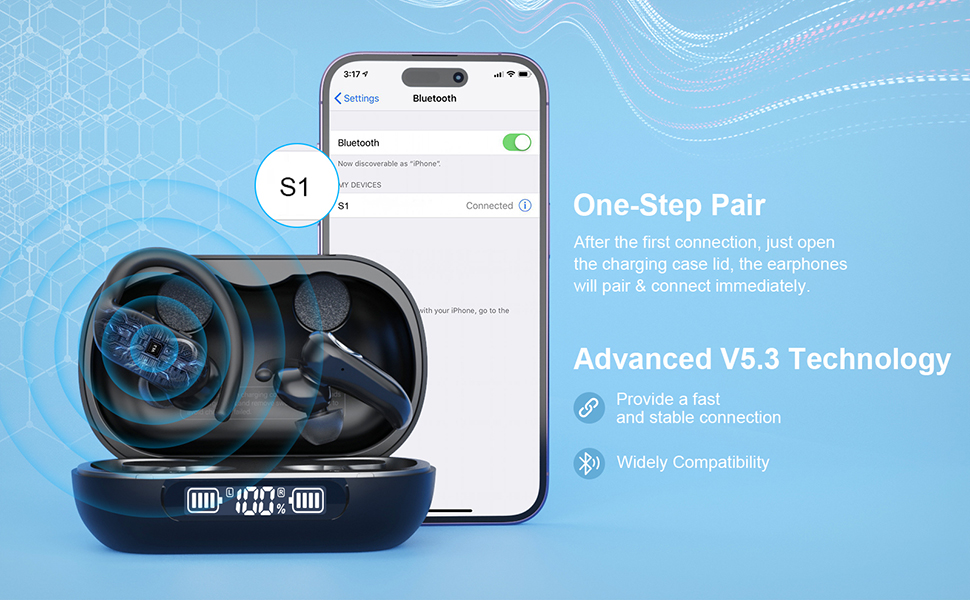
The final link in this chain is the transmission of data. Bluetooth 5.2 serves as the digital pipeline, but raw speed isn’t the only metric. For applications like gaming or video, latency—the delay between the source generating a sound and the ear receiving it—is critical.
Standard Bluetooth connections can suffer from latencies exceeding 200ms, causing a noticeable “lip-sync” error in videos. The Ablebuds Free implement optimized transmission protocols to achieve a latency as low as 90ms. This requires tight integration between the Bluetooth SoC (System on Chip) and the antenna design to minimize packet loss and retransmission requests. By reducing the buffer size and optimizing the codec processing time, the earbuds ensure that the acoustic event synchronizes perceptibly with the visual event, maintaining immersion.
Conclusion: Democratizing Audio Engineering
The UMIDIGI Ablebuds Free illustrate a broader trend in consumer electronics: the commoditization of high-end physics. Technologies like Hybrid ANC and LCP drivers, which require sophisticated understanding of wave mechanics and materials science, are no longer the exclusive domain of luxury brands. By integrating these principles into an accessible package, engineering prowess effectively democratizes the listening experience, allowing a wider audience to experience music not just as background noise, but as a precise, immersive physical phenomenon.