The Physics of Stability: Why Kinetic Design Matters in Workout Audio Gear


DOBOPO A20 Wireless Earbuds
For the dedicated athlete or the weekend jogger, the rhythm of a workout is sacred. Yet, this flow state is too often interrupted by a simple, annoying failure of physics: an earbud slipping loose. The market is saturated with "sport" headphones, but few address the fundamental biomechanical challenge of keeping a sound source stationary on a moving target that is also producing moisture (sweat).
The solution lies not just in stronger connectivity, but in a return to mechanical fundamentals. It requires a shift from relying on friction—which fails when lubrication (sweat) is introduced—to relying on leverage and anatomical anchoring. This engineering philosophy is what separates casual listening devices from true performance gear, a distinction clearly visible in the design architecture of devices like the DOBOPO A20-2 Wireless Earbuds. By examining the mechanics of this device, we can better understand what makes for a resilient workout companion.
The Kinetics of the Ear: Solving the "Fall-Out" Problem
Why do standard in-ear buds fail during a run? It’s a combination of gravity, impact forces (G-force), and the lubricating effect of sweat. When you run, your body moves vertically with every step. A standard earbud relies on the friction between the silicone tip and your ear canal to counteract this downward force. However, once sweat enters the equation, that coefficient of friction drops precipitously.
The engineering solution is to bypass friction as the primary holding force. This is where the "over-the-ear" hook design becomes critical. By utilizing a flexible hook, the earbud effectively changes its center of gravity. The weight is redistributed across the top of the pinna (the outer ear), turning the ear itself into a load-bearing shelf.
The DOBOPO A20-2 utilizes this mechanical advantage through its soft silicone ear hooks. Instead of jamming a device deeper into the canal to ensure a seal—which causes pressure pain over time—the hooks provide a secure, low-pressure anchor. This design choice allows the unit to remain stable even during high-impact activities like burpees or sprinting, where vertical acceleration is highest. It is a triumph of geometry over brute force grip.
Acoustic Compensation: The Role of 14mm Drivers
There is an inherent trade-off in sports audio: safety versus immersion. A completely sealed ear canal provides great bass but creates a "thudding" effect (occlusion effect) with every footstep and blocks out vital environmental cues like traffic. Conversely, a looser fit for safety often kills bass response.
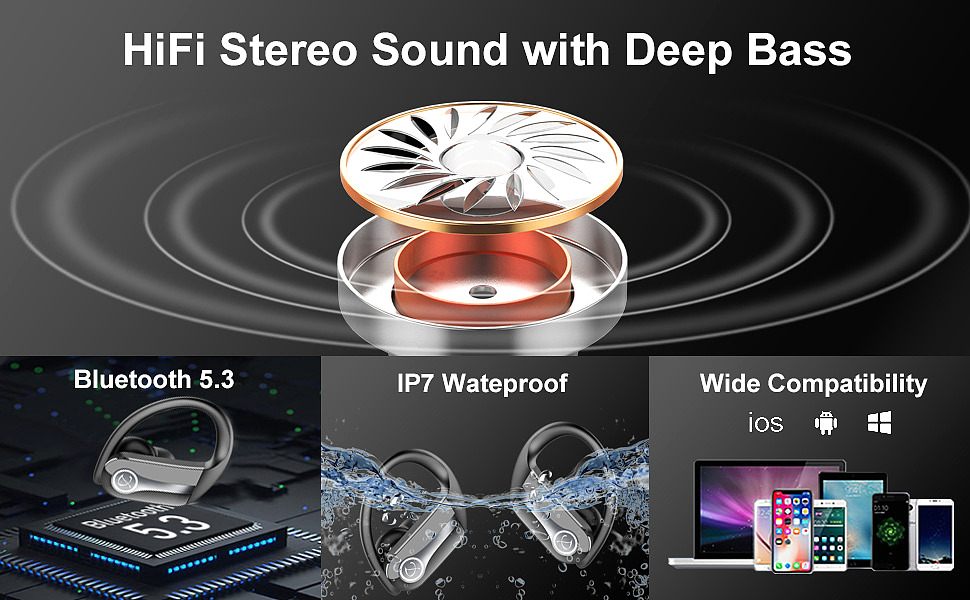
To combat this, audio engineers must move more air. This is why driver size matters immensely in sports applications. While a typical casual earbud might use a 6mm or 8mm driver, performance-oriented devices like the A20-2 employ significantly larger 14mm dynamic drivers.
The physics here is straightforward: a larger diaphragm area allows for greater air displacement. This capability compensates for any loss of seal that might occur during rigorous movement or if the user chooses a lighter fit for situational awareness. The result is that the "triple-layer composite diaphragms" can still deliver the visceral, driving bass lines needed for workout motivation without requiring an uncomfortable, vacuum-like seal. It balances the acoustic need for immersion with the safety need for environmental connection.
Connectivity in Crowded Spectrums
The modern gym is a hostile environment for wireless signals. With dozens of smartphones, smartwatches, and gym equipment all broadcasting on the 2.4GHz band, signal interference is a common hurdle. This manifests as audio dropouts or "stuttering" music—a major disruption to an athlete's focus.
The adoption of Bluetooth 5.3 represents a significant mitigation of these issues. Unlike its predecessors, Bluetooth 5.3 introduces improved channel classification, allowing the earbuds to more intelligently hop between frequency channels to avoid congested areas. For the user, this translates to a consistent, invisible tether between the source device and the earbuds.
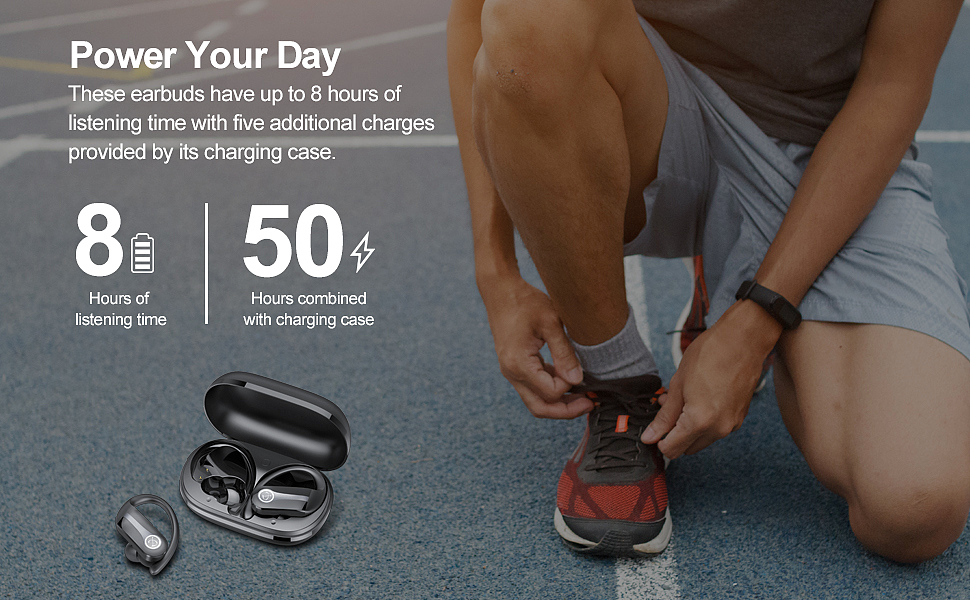
Furthermore, the efficiency of Bluetooth 5.3 contributes directly to power management. Coupled with USB-C fast charging, modern chipsets allow for rapid energy replenishment—a crucial feature for those who often forget to charge their gear until minutes before a workout. The LED power display on the A20-2’s case is a simple yet vital human-machine interface (HMI) element, translating chemical energy (battery life) into visual data, eliminating "range anxiety" for your audio.
Material Science: Defending Against Corrosion
Sweat is not just water; it is a saline solution that is highly corrosive to electronics. An IP (Ingress Protection) rating is not merely a marketing badge; it is a specification of engineering tolerance.
The IP7 rating found on devices like the A20-2 indicates a high level of sealing. Specifically, the '7' denotes capability to withstand temporary immersion in water. In practical terms for a runner, this is overkill for rain, but essential for sweat. Over time, salt crystals from dried sweat can compromise lesser seals and corrode charging contacts. A device engineered to IP7 standards utilizes hydrophobic coatings and tight gasket seals to ensure that the internal circuitry remains isolated from the caustic environment of a rigorous workout. This durability is what transforms a piece of electronics into a piece of athletic equipment.
Conclusion: The Intersection of Form and Function
When selecting audio gear for an active lifestyle, the evaluation criteria must shift. It is no longer just about the fidelity of the high notes in a quiet room; it is about the reliability of the bass line at mile five of a run in the rain.
The DOBOPO A20-2 serves as a prime example of accessible engineering solving specific biomechanical problems. By leveraging the mechanical stability of ear hooks, the acoustic power of large dynamic drivers, and the robust connectivity of Bluetooth 5.3, it addresses the distinct variables of the "workout equation." For the consumer, understanding these underlying mechanics—anchoring, displacement, and ingress protection—is the key to finding gear that doesn't just play music, but actively supports the pursuit of performance.
DOBOPO A20 Wireless Earbuds
Related Essays

Why Your $35 Earbuds Survived the Washing Machine: The Physics of Waterproof Bluetooth Engineering

The Athlete's Audio Triathlon: Decoding the 3 Pillars of a True Sport Earbud

Decoding the Sport Earbud: 5 Specs That Define a True Workout Headphone

Anypub A11 Wireless Earbuds: Your Ultimate Audio Companion for Crystal-Clear Calls and Immersive Music

Pump Up Your Workouts with the TREBLAB Z2s: Sweatproof Bluetooth Headphones Built for Exercise

Hybrid Driver IEM Amplifier Pairing: Impedance Matching and the 1/8 Rule

Balanced Armature Drivers Explained: How Quad-Driver IEMs Separate Frequencies

Sport Earbuds Technology Explained: The Physics of Fit, Waterproofing, and Sound

Noise Isolation Earphones: Why Your Seal Matters More Than Your Specs

