Acoustic Autonomy: The Convergence of RF Physics and AI in Modern Headsets
Update on Feb. 11, 2026, 5:06 p.m.
The modern workspace is no longer confined to a cubicle; it is a fluid concept that exists wherever a signal can be established. In this nomadic digital landscape, the headset has evolved from a simple transducer into a sophisticated communication node. It must negotiate crowded radio frequencies, filter complex acoustic environments using artificial intelligence, and manage power reserves for days on end.
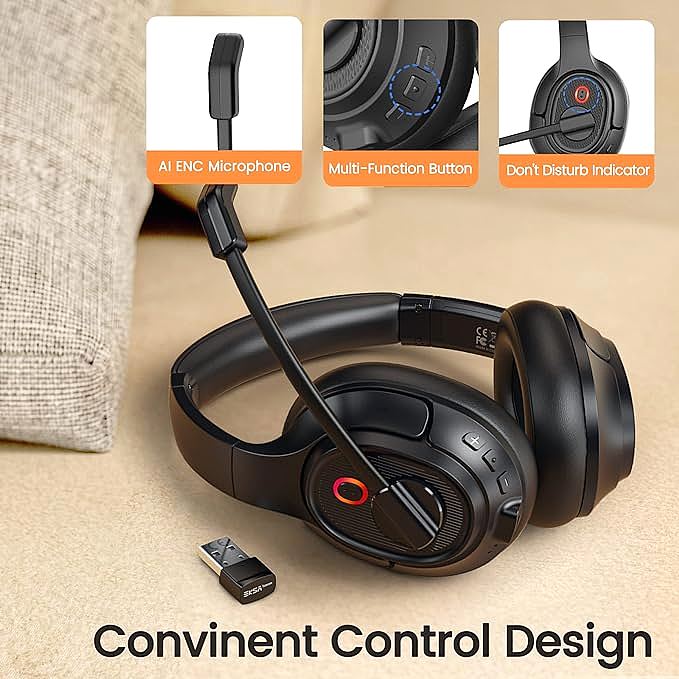
This analysis deconstructs the EKSA H16 to understand the underlying science of reliable communication. We will explore how dual-mode wireless architectures solve the latency-bandwidth trade-off, how neural networks are trained to silence chaos, and the energy management strategies that push runtime beyond the standard work week.

Navigating the 2.4 GHz Spectrum
Wireless audio is fundamentally a challenge of radio frequency (RF) engineering. Most consumer wireless devices operate in the 2.4 GHz ISM (Industrial, Scientific, and Medical) band. This creates a crowded spectral environment where Wi-Fi routers, microwaves, and Bluetooth devices compete for airtime.
The Latency vs. Stability Trade-off
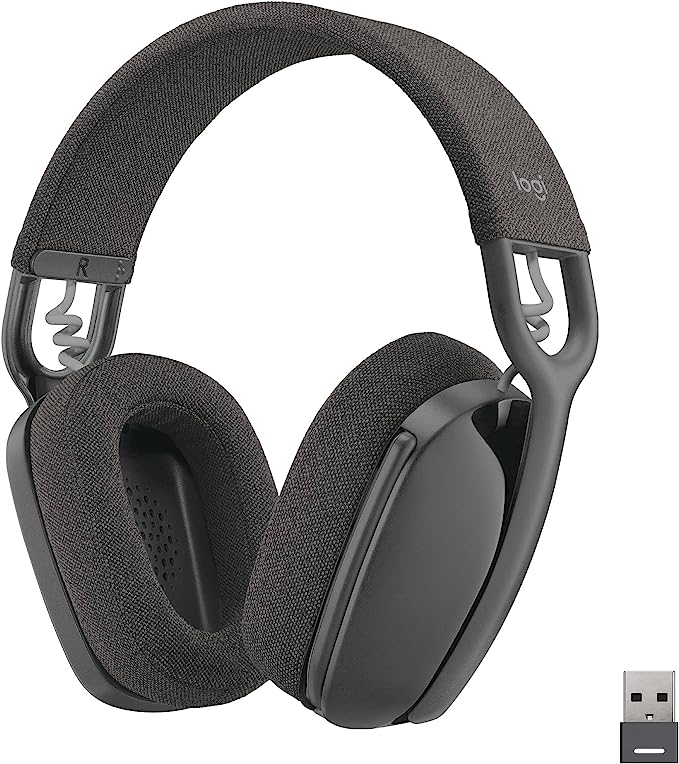
The EKSA H16 employs a dual-mode architecture, utilizing both Bluetooth 5.2 and a proprietary 2.4 GHz USB dongle. While both operate in the same frequency range, their transmission protocols differ significantly in how they handle data packets.
- Bluetooth Protocol: Designed for compatibility and low power, standard Bluetooth hops frequencies rapidly (1,600 times per second) to avoid interference. However, the negotiation process and packet confirmation can introduce latency—often between 100ms to 200ms. This is acceptable for music but can create a perceptual disconnect in real-time communication or gaming.
- Proprietary 2.4 GHz (The Dongle): The USB dongle bypasses the standard Bluetooth stack. It typically uses a fixed-frequency or optimized hopping scheme with smaller packet headers. This streamlines the “handshake” between transmitter and receiver, drastically reducing latency to perceptible near-zero levels (often <30ms).
For the user, this duality offers a functional choice: the ubiquity of Bluetooth for mobile connectivity, or the low-latency precision of the RF dongle for stationary, high-bandwidth tasks like video conferencing or competitive gaming.
Algorithmic Isolation: Defining the Voice
In a room filled with the hum of HVAC systems, the clatter of keyboards, and distant conversations, a microphone faces the “Cocktail Party Problem”: how to focus on a single voice source while suppressing competing signals.
Neural Networks in Signal Processing
The AI-Powered Environmental Noise Cancellation (ENC) chip within the H16 represents a shift from traditional subtractive audio processing to generative/predictive modeling. Traditional noise gates simply cut audio when volume drops below a threshold. AI ENC, however, utilizes a Deep Neural Network (DNN).
This network has been trained on massive datasets containing thousands of hours of human speech mixed with various noise types. Through this training, the algorithm learns the spectral characteristics of the human voice—its harmonic structure, pitch variance, and formant frequencies. When audio enters the microphone, the chipset creates a spectral mask in real-time. It effectively “decomposes” the sound wave, preserving the components that match the “voice” model and attenuating components identified as “noise” (transient or continuous).
This computational approach allows for dynamic adaptation. Whether the interference is a steady fan (stationary noise) or a sudden dog bark (non-stationary noise), the algorithm adjusts its suppression parameters milliseconds faster than human reaction time, ensuring the transmission remains intelligible.
Thermodynamics of Long-Duration Power
Energy density is the limiting factor of portable electronics. The H16’s claim of 55 hours of playtime suggests a rigorous optimization of the power budget, balancing battery capacity with component efficiency.
System-on-Chip (SoC) Efficiency
The longevity of modern headsets is driven by advancements in Bluetooth SoCs. These chips have moved from older manufacturing processes (e.g., 40nm) to more efficient nodes (22nm or smaller). This reduction in transistor size lowers the leakage current and the voltage required to switch states.
Furthermore, the implementation of Bluetooth Low Energy (BLE) concepts into audio transmission allows the device to aggressive sleep states. When silence is detected in the audio stream, the amplifier and transmission radio can cycle into micro-sleep modes, preserving milliwatts that accumulate over hours. This intelligent duty cycling is what allows a battery of relatively modest physical size to sustain operation for nearly a full week of typical business use.
Anthropometric Engineering: The Interface
The final link in the audio chain is the mechanical interface with the human body. Ergonomics is physics applied to biology. A headset must exert enough clamping force to maintain a seal and stability, but not so much that it restricts capillary blood flow in the soft tissues around the ear.
The H16 utilizes an over-ear (circumaural) design. By encircling the pinna (the outer ear) rather than pressing against it, the force is distributed across the larger surface area of the skull. This reduces the pressure per square inch (PSI) significantly compared to on-ear designs.
The ear cushions, typically made of protein leather and memory foam, serve a dual purpose: comfort and passive noise isolation. The memory foam creates a viscoelastic seal that conforms to the irregular contours of the jaw and temple. This physical barrier attenuates high-frequency environmental noise before it even reaches the ear canal, complementing the active electronic systems and creating a quieter acoustic chamber for the listener.
Conclusion
The EKSA H16 illustrates that a wireless headset is more than just speakers on a headband. It is a complex integration of radio frequency engineering, machine learning signal processing, and material science. By understanding the mechanisms of low-latency transmission and AI-driven noise suppression, users can better appreciate the sophisticated technology that enables clear, uninterrupted communication in an increasingly noisy world.