Anatomy of a Failure: When Ergonomics Meets Entropy
Update on Jan. 1, 2026, 10:38 a.m.
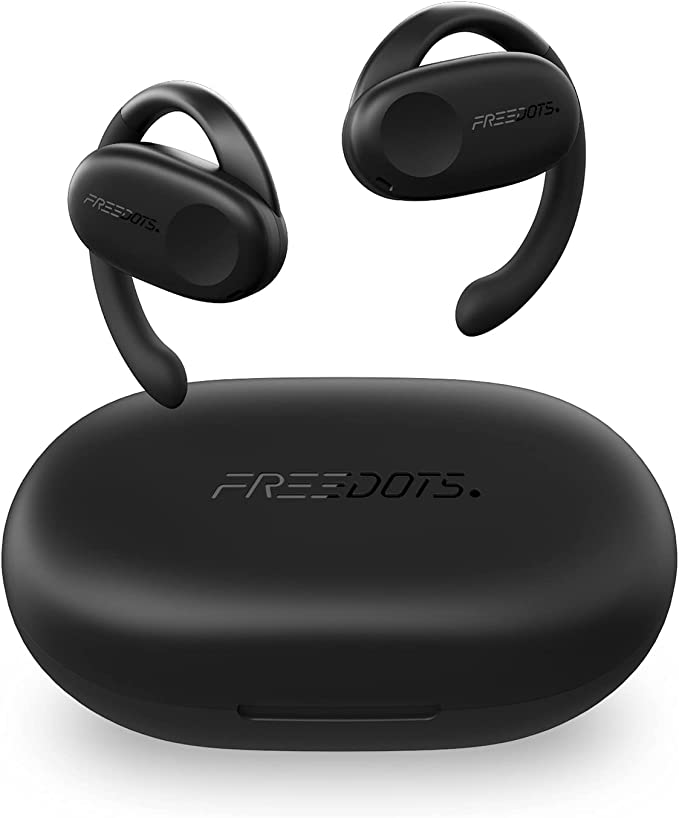
Imagine you are mid-sprint on a treadmill. An adrenaline-pumping track comes on, but it is deafeningly loud. You reach up to tap your earbud to lower the volume—and nothing happens. You fumble for your phone, break your stride, and nearly fly off the belt. This is not a user error; it is a fundamental UX failure (The Horror Story). The FREEDOTS C1-FD001 is a marvel of open-ear physics, but structurally and interactively, it walks a fine line between innovation and fragility.

The Missing Interface: Volume Control
In the hierarchy of wearable controls, volume is paramount. Yet, the C1 omits this entirely on the device itself (Thesis). As noted by user Nila, “there isn’t volume control except through voice command… or directly through your phone.”
The Safety Implication
This is not merely inconvenient; it is a safety hazard for an “active sport” device. If you are cycling and need to hear traffic suddenly, you cannot suppress the audio instantly without voice commands—which are unreliable in wind—or taking your hands off the handlebars (Scenario).
The Bluetooth Protocol Gap
Technically, this suggests the device may rely on “Absolute Volume” via the AVRCP profile but lacks the physical inputs (capacitive touch or physical buttons) mapped to send the VOL_DOWN command (Expert Nuance). It forces the user to be tethered to the source device, negating some of the freedom promised by “wireless” range.
Field Note: If you are stuck with these buds and hate the volume issue, smartwatches are the only viable workaround. Pairing the C1 to your phone while controlling volume via an Apple Watch or Garmin is the only way to maintain “hands-free” safety during high-speed activities.
Structural Fatigue: The Hinge Problem
The COMFORT TURN 120° hinge is the C1’s selling point, but also its structural Achilles’ heel. User Peter Zuccaro reported, “The ear hook has broken on two of these on me.” This suggests a systemic issue, likely Cyclic Stress Fatigue (FMEA).
Material Mismatch
The ear hooks utilize TPU (Thermoplastic Polyurethane), a flexible polymer (Data). However, the hinge mechanism likely involves a metal pin or a rigid plastic knuckle. The interface where the flexible TPU meets the rigid hinge creates a “stress concentration point” (Physics). Every time you rotate the hook to fit your ear, micro-fractures can form at this junction. Over months of daily adjustment, these propagate until catastrophic failure occurs—the hook simply snaps off.
The Repairability Dead End
Unlike over-ear headphones where pads or bands are replaceable, the C1 is a sealed unit. A broken hook renders the electronics useless. There are no replacement parts sold, turning a mechanical failure into a total financial loss (TCO Impact).
The Corrosion Reality: IPX4 vs. Sweat
The spec sheet claims IPX4 water resistance. Let us decode that rating. IPX4 means protection against “splashing water.” It does not certify protection against pressurized jets (IPX5) or immersion (IPX7) (General Knowledge).
The Saline Factor
More importantly, IP ratings test with fresh water. Sweat is saline—an electrolyte solution capable of bridging circuits and corroding metal contacts rapidly (Chemistry). The charging points on the C1 are exposed. If sweat pools in the charging case or dries on the contacts, it forms a layer of insulating oxide or green copper corrosion. This explains user reports of earbuds “randomly disconnecting” or failing to charge—it is often a contact failure, not a battery death (Detective Logic).
Field Note: Never put the C1s directly into the case after a workout. The “Sweatproof” claim is for the internal electronics, not the external charging contacts. Always wipe the gold contacts with a microfiber cloth (or your shirt) to remove conductive salts before docking them. This 5-second habit can double the device’s lifespan.
Verdict: A Specialized Tool with Caveats
The FREEDOTS C1 is an excellent acoustic instrument for those who hate earplugs. The 28 Ohm impedance and directional drivers deliver clarity that rivals more expensive units. However, as a piece of hardware, it demands care. It is not a “throw in your gym bag and forget it” tank. It requires gentle handling of the hinge and diligent cleaning of the contacts. It is a precision instrument, unfortunately housed in a chassis that is slightly less robust than the lifestyle it markets to.