The Invisible Spectrum: The Physics of Infrared Thermometry and Thermopile Engineering
Update on Jan. 1, 2026, 8:49 a.m.
The human body is a luminous object. To the naked eye, we reflect visible light, appearing as solid biological forms. But in the electromagnetic spectrum, specifically in the infrared (IR) band, we are glowing beacons of thermal energy. Every metabolic process, every beat of the heart, and every chemical reaction within our cells generates heat, which is radiated outward into the environment.
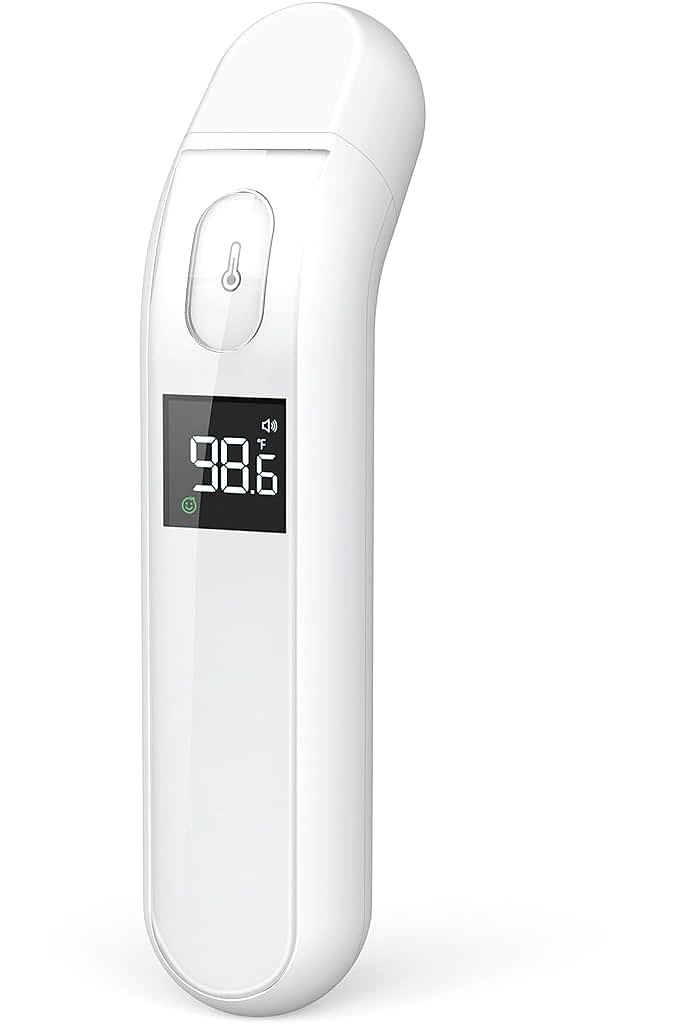
The iHealth PT2L Digital Thermometer is not merely a household gadget; it is a sophisticated photon detector. It is tuned to “see” this invisible light of life. By capturing the thermal radiation emitted from the forehead and converting it into a digital signal, it provides a window into the body’s internal state without ever touching the skin. This article deconstructs the physics of blackbody radiation, the micro-engineering of thermopile sensors, and the rigorous geometry required for accurate non-contact measurement.
The Physics of Thermal Radiation: We Are All Light Sources
To understand how a thermometer can work without contact, we must revisit the fundamental laws of thermodynamics and quantum mechanics. All matter with a temperature above absolute zero (-273.15°C) consists of vibrating atoms. These accelerating charges emit electromagnetic waves.
The Stefan-Boltzmann Law
The intensity of this radiation is not random. It is strictly governed by the Stefan-Boltzmann Law:
$$j^{\star} = \varepsilon \sigma T^4$$
This equation states that the total power radiated per unit surface area ($j^{\star}$) is directly proportional to the fourth power of the thermodynamic temperature ($T$).
* Sensitivity: Because radiation scales to the power of four, a small increase in body temperature (e.g., from 37°C to 38°C) results in a relatively large increase in radiated energy. This physical property allows IR thermometers to be incredibly sensitive to fever.
* Wavelength: According to Wien’s Displacement Law, human body temperature peaks in the long-wave infrared region (around 9-10 micrometers). The iHealth PT2L uses a specialized lens filter (often silicon or germanium) that is transparent only to this specific wavelength range, blocking out visible light and other interference.
Emissivity: The Biological Constant
The variable $\varepsilon$ (Emissivity) in the equation is critical. It represents how efficiently an object radiates heat compared to a perfect black body ($\varepsilon=1.0$).
Remarkably, human skin has an emissivity of ~0.98, regardless of skin color, race, or age. This high and stable emissivity makes the forehead an almost perfect “thermal radiator” for diagnostic purposes. The PT2L’s algorithm is hard-coded with this constant, allowing it to translate the incoming photon flux directly into a temperature reading with high precision.
Sensor Engineering: The Thermopile Matrix
Inside the sleek white casing of the PT2L lies a micro-electro-mechanical system (MEMS) known as a Thermopile. This is the eye of the device.
The Seebeck Effect at Micro-Scale
A thermopile is constructed from a series of thermocouples.
1. Absorption: When IR radiation from the forehead enters the lens, it hits a “hot junction” on the sensor chip, which is coated with a high-absorptivity material (carbon black or gold black).
2. Conversion: This energy is converted into heat, raising the temperature of the hot junction relative to a “cold junction” on the chip substrate.
3. Voltage Generation: Due to the Seebeck Effect, this temperature difference generates a voltage potential.
The magnitude of this voltage is directly proportional to the intensity of the IR radiation, and thus, the temperature of the forehead.
Cold Junction Compensation (CJC)
However, the sensor itself is sitting in a room that has its own temperature. If the thermometer is cold (e.g., just brought in from a car), the “cold junction” will be colder, creating a larger $\Delta T$ and potentially a false high reading.
To correct for this, the PT2L includes a secondary Ambient Temperature Sensor (a thermistor) near the cold junction. The microprocessor measures the device’s own temperature and subtracts this “thermal noise” from the signal. This mathematical correction, known as Cold Junction Compensation, is what allows the thermometer to be accurate across a range of operating environments (though it still requires acclimatization, as discussed later).

The Geometry of Measurement: Distance-to-Spot Ratio
While the physics is sound, the application relies on Geometry. The sensor has a Field of View (FOV), like a camera lens. * The Cone of Vision: The sensor “sees” a cone of space expanding outward from the lens. * The Target Area: The measurement is an average of everything within that cone.
The 1.18 Inch Constraint
The PT2L specifies a measuring distance of 1.18 inches (3 cm) or less. Why this specific number?
It is governed by the Distance-to-Spot (D:S) Ratio. As you move the thermometer away from the forehead, the “spot” size increases.
* Correct Distance (<1.18 in): The spot size is smaller than the forehead. The sensor sees only skin. The reading is accurate.
* Incorrect Distance (>2 in): The spot size becomes larger than the forehead. The sensor starts to “see” the cooler air surrounding the head, or the hair. The reading becomes an average of the hot skin and the cold air, resulting in a dangerously false low reading (e.g., reading 98°F when the patient is actually 101°F).
This geometric constraint is the most critical user variable. The design of the PT2L often includes a concave shroud around the lens to help users intuitively gauge this distance and shield the sensor from stray lateral radiation.
Signal Processing: The 1-Second Algorithm
The “Instant, Accurate Results” claim relies on rapid Digital Signal Processing (DSP). The raw voltage from a thermopile is analog and noisy.
1. Amplification: The microvolt-level signal is amplified.
2. A/D Conversion: An Analog-to-Digital converter turns the voltage into binary data.
3. Linearization: The relationship between voltage and temperature is non-linear. The processor applies a linearization curve based on the Stefan-Boltzmann law.
4. Averaging: In that single second, the device likely takes dozens or hundreds of samples and averages them to filter out electronic noise.
This computational pipeline converts a chaotic stream of photons into a stable, medical-grade data point in the blink of an eye.
Conclusion: The Passive Observer
The iHealth PT2L represents a triumph of passive sensing. Unlike ultrasound or X-ray, it emits nothing. It simply observes. It listens to the thermal song of the body.
By mastering the physics of infrared radiation, the thermoelectric generation of voltage, and the geometry of optics, it transforms a complex thermodynamic phenomenon into a simple, actionable number. It bridges the gap between the invisible world of heat and the visible world of health data, providing a tool that is as scientifically rigorous as it is easy to use.