Specs Decoded: Bluetooth 5.4, IP7, and the Rise of Sustainable Audio in the Donerton I66
Update on Nov. 24, 2025, 11:37 a.m.
In the turbulent ocean of consumer electronics, new devices often arrive as a collection of acronyms and version numbers. For the savvy consumer, the challenge lies not in reading the spec sheet, but in translating it into real-world utility.
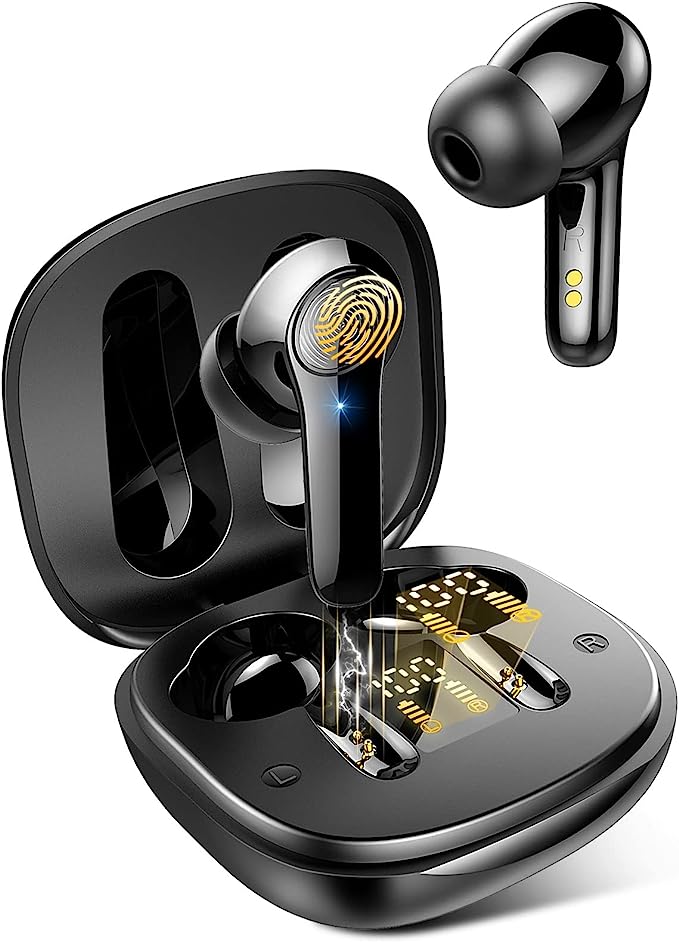
The Donerton I66 Wireless Earbuds present an interesting case study in this “spec-sheet evolution.” Arriving with Bluetooth 5.4, an IP7 waterproof rating, and a rare Carbonfree Certification, they represent a shift in what is expected from entry-level audio. Rather than reviewing the subjective “soul” of the music, let us dissect the objective engineering behind these specifications to understand what they actually deliver to the user.

The Leap to Bluetooth 5.4: Connectivity Physics
The headline feature of the I66 is the inclusion of Bluetooth 5.4. For many, Bluetooth versions are just incrementing integers, but the jump from 5.0 or 5.3 to 5.4 involves significant protocol optimizations.
Bluetooth 5.4 introduces enhancements primarily focused on Periodic Advertising with Response (PAwR) and Encrypted Advertising Data (EAD). * Signal Robustness: In practical terms, version 5.4 improves the device’s ability to maintain a stable handshake with the host device (phone/laptop) in congested radio frequency environments—think subway stations or crowded gyms where hundreds of signals fight for the 2.4GHz band. * Energy Efficiency: By optimizing how data packets are advertised and acknowledged, the chipset consumes less power during idle and standby states. This theoretically extends the effective operating time of the lithium-polymer batteries housed within the earbuds, addressing the perennial “battery anxiety” of wireless gear.
Decoding IP7: The Limits of Waterproofing
Water resistance is often marketed with vague terms like “sweatproof.” However, the IP (Ingress Protection) rating system provides a precise engineering definition. The I66 carries an IP7 rating (often written as IPX7 when dust resistance is not tested).
- The Standard: An IPX7 rating certifies that the device can withstand immersion in fresh water up to 1 meter deep for 30 minutes without harmful ingress.
- The Reality: This makes the device effectively immune to rain, sweat, and even accidental drops into a sink.
- The Misconception: Crucially, physics dictates that Bluetooth signals (2.4GHz microwaves) are heavily attenuated by water. While the hardware can survive underwater, the connection cannot. Therefore, IP7 devices are designed for durability against accidents, not for swimming. It is an insurance policy for your hardware, not a license for aquatic listening.

The Sustainability Factor: Carbonfree Audio
Perhaps the most distinguishing feature of the I66 is not acoustic, but environmental. The product listing highlights Carbonfree and Climate Pledge Friendly certifications. In the budget electronics sector, where “disposable” is often the norm, this is a significant deviation.
This certification implies a Life Cycle Assessment (LCA) has been performed.
1. Measurement: Calculating the carbon footprint of raw materials (plastic, lithium, copper), manufacturing energy, and logistics.
2. Offsetting: Investing in renewable energy or reforestation projects to neutralize the calculated emissions.
For the eco-conscious consumer, this transforms a simple purchase into a vote for responsible manufacturing practices. It suggests a supply chain that is aware of its impact, a rarity at this price point.
Audio Architecture: Isolation vs. Cancellation
Navigating audio terminology can be treacherous. The I66 features “Noise Cancelling Mic” and “Sound Isolation.” It is vital to distinguish these from Active Noise Cancellation (ANC).
- Passive Sound Isolation: The I66 utilizes an In-Ear form factor. By physically sealing the ear canal with silicone tips, it blocks high-frequency environmental noise (like chatter or keyboard clicks). This is a mechanical effect, requiring no power and introducing no digital artifacts.
- ENC (Environmental Noise Cancellation): The “Noise Cancelling Mic” refers to the uplink (what the person on the other end of the call hears). Using signal processing algorithms, the microphone array filters out background noise from your environment before transmitting your voice. It ensures you are heard clearly, but it does not silence the world for you.
Conclusion: The New Baseline
The Donerton I66 serves as a marker for the new baseline in affordable audio. Features that were once premium—latest-gen connectivity, immersion-grade waterproofing, and environmental accountability—are becoming standard expectations.
For the consumer, this means the decision-making process is no longer just about “does it play music?” It is about “will it stay connected in a crowd?”, “will it survive a rainstorm?”, and “does it align with my values?”. By decoding the specs of Bluetooth 5.4 and IP7, we see a device engineered not just for sound, but for the resilience and responsibility required by modern life.