Electrostatic Transduction: The Engineering of Vocal Clarity
Update on Feb. 2, 2026, 2:55 p.m.
In the domain of audio communication, the clarity of the transmitted voice is not merely a matter of volume; it is a function of signal fidelity and noise rejection. While modern software algorithms play a significant role in filtering background noise, the primary determinant of audio quality remains the physical transducer—the microphone. Specifically, the electret condenser microphone represents a pivotal intersection of material science and electrostatics, offering a solution that combines high sensitivity with a lightweight form factor. Understanding how these devices capture sound, and how the acoustic environment is controlled via ear cup geometry, reveals the sophisticated engineering required for effective digital communication.
The Physics of the Electret Condenser
Unlike dynamic microphones, which rely on the movement of a heavy coil within a magnetic field, condenser microphones operate on the principle of variable capacitance. A capacitor consists of two plates: a fixed backplate and a movable diaphragm. When sound waves strike the diaphragm, it vibrates, changing the distance between the two plates. This fluctuation in distance alters the capacitance, which in turn generates an electrical signal proportional to the acoustic waveform.
Traditionally, condenser microphones required an external power source to maintain an electrostatic charge on the capacitor plates. The electret condenser, utilized in systems like the Koss CS200 USB, circumvents this need through the use of a specialized material—the electret. This material, typically a fluoropolymer, is permanently polarized with a quasi-permanent static electric charge during the manufacturing process. This “frozen” charge creates the necessary electrostatic field without requiring a bulky external power supply.
The advantage of this architecture lies in the mass of the diaphragm. Because it does not need to carry a voice coil, the electret diaphragm can be exceedingly light. This low mass allows it to respond rapidly to the transient attacks of human speech—the sharp consonants and plosives that define intelligibility. The result is a transducer with superior transient response and high-frequency sensitivity compared to dynamic counterparts, ensuring that the nuances of voice are captured with precision.
Differential Noise Cancellation Mechanics
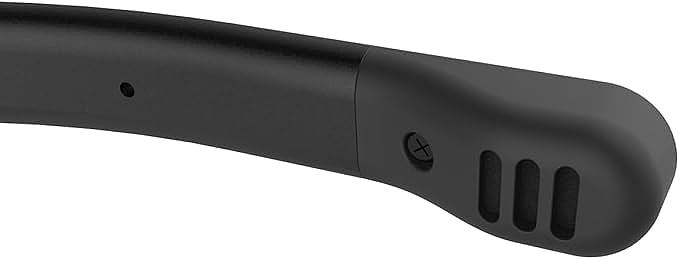
Capturing the voice is only half the equation; rejecting environmental noise is equally critical. The “noise-cancelling” capability of a boom microphone is often achieved through a pressure-gradient principle. In this design, the microphone capsule is ported on both the front and the back.
Sound originating from a distance (ambient noise) arrives at both ports almost simultaneously and with equal intensity. Because the pressure is applied to both sides of the diaphragm effectively at once, the net movement of the diaphragm is minimized—the opposing forces cancel each other out. However, the user’s voice, originating from a source very close to the front port (the mouth), creates a significant pressure differential between the front and rear ports. This differential drives the diaphragm, generating a strong signal for the voice while attenuating distant background sounds. This physical filtering mechanism is essential for maintaining a high Signal-to-Noise Ratio (SNR) in busy environments like open offices or call centers.
Geometric Acoustics: The D-Profile Seal
The interface between the headset and the user is governed by geometric acoustics. The traditional circular ear cup often conflicts with the actual anatomy of the human ear, which is not perfectly round. This mismatch can lead to gaps in the acoustic seal, allowing ambient noise to leak in (ingress) and audio frequencies, particularly lower ones, to leak out (egress).

To address this, engineering designs like the D-Profile used in the Koss CS200 mimic the natural shape of the ear. This vertical “D” shape aligns with the pinna and the jawline, creating a more consistent contact patch. A superior seal serves two acoustic functions:
1. Passive Noise Isolation: It physically blocks high-frequency environmental noise from reaching the ear canal, reducing the cognitive load on the listener who no longer needs to strain to hear.
2. Bass Response Coupling: A tight seal creates a closed acoustic chamber. This coupling is necessary for the efficient transfer of low-frequency energy. Without it, bass frequencies dissipate, leading to a “tinny” or thin sound profile. By optimizing the geometry, the headset ensures a linear frequency response across the specified 20-22,000 Hz range.
Future Outlook: MEMS and Beamforming
While electret condensers currently dominate the headset market due to their cost-performance ratio and reliability, the future of vocal capture is moving toward Micro-Electro-Mechanical Systems (MEMS). MEMS microphones, etched directly onto silicon chips, offer even greater consistency and smaller footprints. Future iterations of communication headsets will likely employ arrays of MEMS microphones working in tandem with digital signal processors to perform active beamforming—electronically steering the “listening” direction of the microphone array to focus specifically on the speaker’s mouth, further isolating the voice from the acoustic environment.