The Physics of Impact: Re-evaluating Physical Buttons and 14.2mm Drivers in the TRANYA M10
Update on Nov. 24, 2025, 11:23 a.m.
In the relentless pursuit of sleekness, the modern wireless earbud has largely shed its physical controls. Capacitive touch surfaces have replaced buttons, and drivers have shrunk to fit into increasingly inconspicuous housings. While aesthetically pleasing, these trends often introduce functional compromises: accidental touches, finicky controls, and sound that relies heavily on digital processing to compensate for a lack of physical air displacement.
The TRANYA M10 represents a divergence from this path. By retaining mechanical buttons and housing a massive 14.2mm driver, it prioritizes function and physics over form factor. To understand the value of this approach, we must examine the engineering principles of Haptic Certainty and Acoustic Displacement.
The Engine of Sound: Why 14.2mm Matters
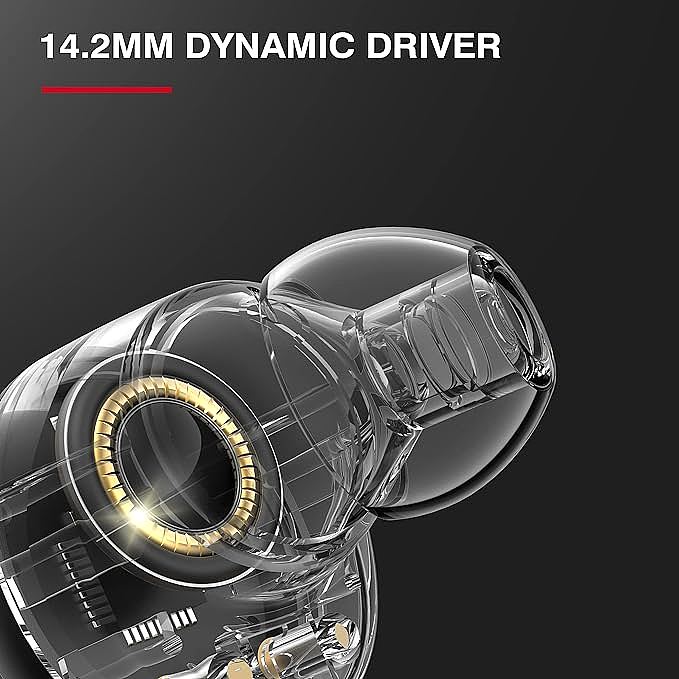
In acoustic engineering, bass response is largely a function of air displacement. To produce low frequencies, a driver needs to move a significant volume of air. Most True Wireless Stereo (TWS) earbuds utilize drivers between 6mm and 10mm. The TRANYA M10 employs a 14.2mm dynamic driver.
Mathematically, the surface area of a 14.2mm driver is more than double that of a standard 10mm driver. * Air Displacement: This increased surface area allows the driver to push more air with less excursion (movement). This results in a deeper, more resonant bass floor that is physically generated, rather than artificially boosted by Digital Signal Processing (DSP). * Headroom: Larger drivers typically operate with greater “headroom,” meaning they can handle dynamic peaks (like a sudden drum kick) without distorting.
However, size introduces a problem: Cone Breakup. Larger diaphragms can wobble and distort at high frequencies. This is where the Graphene material comes into play.

The Graphene Solution
Graphene is a material composed of a single layer of carbon atoms. It is characterized by extreme stiffness and low mass. By coating the M10’s large PET diaphragm with graphene, engineers increase its rigidity. This allows the large 14.2mm surface to move as a unified piston even at high frequencies, preventing the muddiness often associated with large, cheap drivers. The result is a sound signature that maintains clarity in the treble while leveraging the sheer physical size for bass impact.
The Interface Rebellion: Capacitive vs. Mechanical
The industry standard for earbud control is the Capacitive Touch Sensor. It detects changes in electrical charge when a finger approaches. While futuristic, it suffers from a critical flaw: it cannot distinguish between a finger, a wet hoodie, or a sweaty lock of hair. This leads to “phantom touches”—pausing music mid-workout or hanging up calls accidentally.
The M10 utilizes a Physical Button Mechanism. * Haptic Certainty: A mechanical switch requires a specific actuation force to trigger. This provides tactile feedback—a “click”—that confirms the command has been registered. * Zero False Positives: Physics dictates that a button will not be pressed by sweat or hair. For users engaged in high-intensity activities or those wearing gloves, this mechanical reliability is superior to any software algorithm. It restores a sense of control that touch surfaces often erode.

The Trade-off: Form Factor and Battery Density
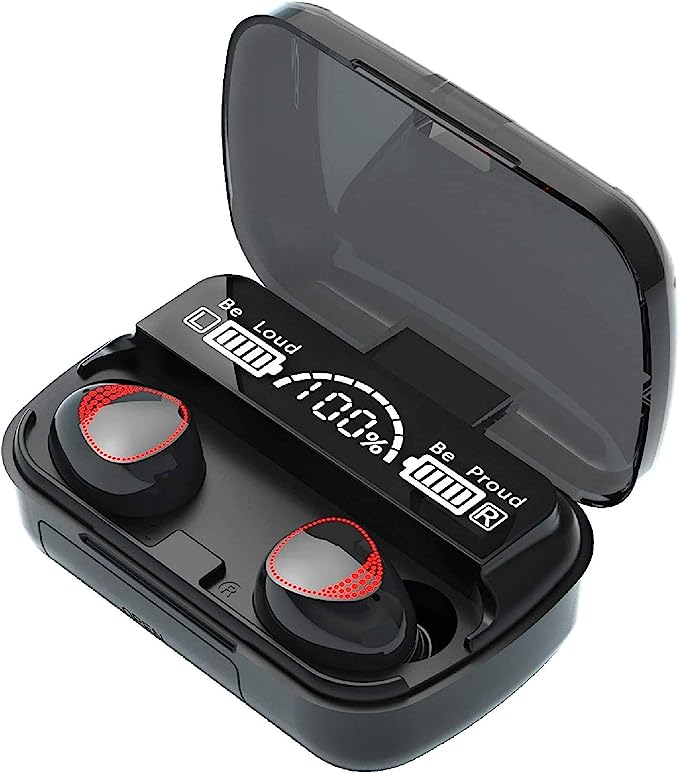
The decision to use large drivers and physical buttons necessitates a larger chassis. The M10 earbuds are physically substantial, sitting prominently in the ear. This volume, however, allows for a larger internal battery.
Energy density is linear. A larger casing accommodates a larger lithium-ion cell. The M10 achieves a continuous playtime of roughly 7 hours (varies by volume), with the case extending this to over 30 hours. This is the direct benefit of accepting a larger form factor. The case itself, often described as “egg-like,” prioritizes battery capacity (800mAh) over slim pocketability. It is a utilitarian trade-off: bulk for power.

Signal Clarity: The 4-Mic Array
While the M10 lacks Active Noise Cancellation (ANC) for the listener, it employs Environmental Noise Cancellation (ENC) for the caller using a 4-microphone array.
This system works on the principle of Beamforming. By comparing the time-of-arrival of sound waves at different microphones, the chipset can calculate the direction of the sound. It then creates a “virtual cone” of sensitivity directed at the mouth, while suppressing sounds arriving from off-axis angles (background noise). This ensures that while you may hear the world around you (due to passive isolation only), the person on the other end of the call hears primarily your voice.

Conclusion: The Utilitarian Choice
The TRANYA M10 is not a fashion accessory. It does not disappear into the ear, nor does it offer the magic of silence through ANC. Instead, it is an audio tool built on fundamental physics.
It leverages a 14.2mm graphene driver to move air efficiently for genuine bass response. It uses physical buttons to ensure control reliability in all conditions. It accepts a larger form factor to deliver extended battery life. For the user who values the certainty of a click and the impact of a large driver over the sleekness of a touch-sensitive bud, the M10 represents a logical, engineering-led choice.